High FSH Levels in Women: Causes, Fertility Challenges and IVF Options
High FSH levels in women can sometimes indicate changes in ovarian function and may affect their ability to conceive. For women planning a pregnancy, understanding follicle-stimulating hormone (FSH) levels is an important step in evaluating fertility. Although high FSH may indicate reduced ovarian reserve, it does not automatically mean that pregnancy is impossible.
At Continental Fertility Center, Hyderabad, fertility specialists evaluate hormone levels alongside age, medical history, ultrasound findings, and other fertility tests. Understanding the causes of high FSH can help women explore suitable treatment options, including in vitro fertilization (IVF), based on their individual reproductive health.
What Are High FSH Levels in Women?
Follicle-stimulating hormone is produced by the pituitary gland in the brain. It helps stimulate the growth and development of ovarian follicles, which contain eggs. When the ovaries respond less effectively, the brain may produce more FSH to encourage follicle development.
High FSH levels may suggest reduced ovarian reserve, particularly when measured early in the menstrual cycle. However, results can vary depending on age, menstrual timing, and other factors. A fertility specialist can interpret the results accurately.
What Causes High FSH Levels?
Common high FSH levels include:
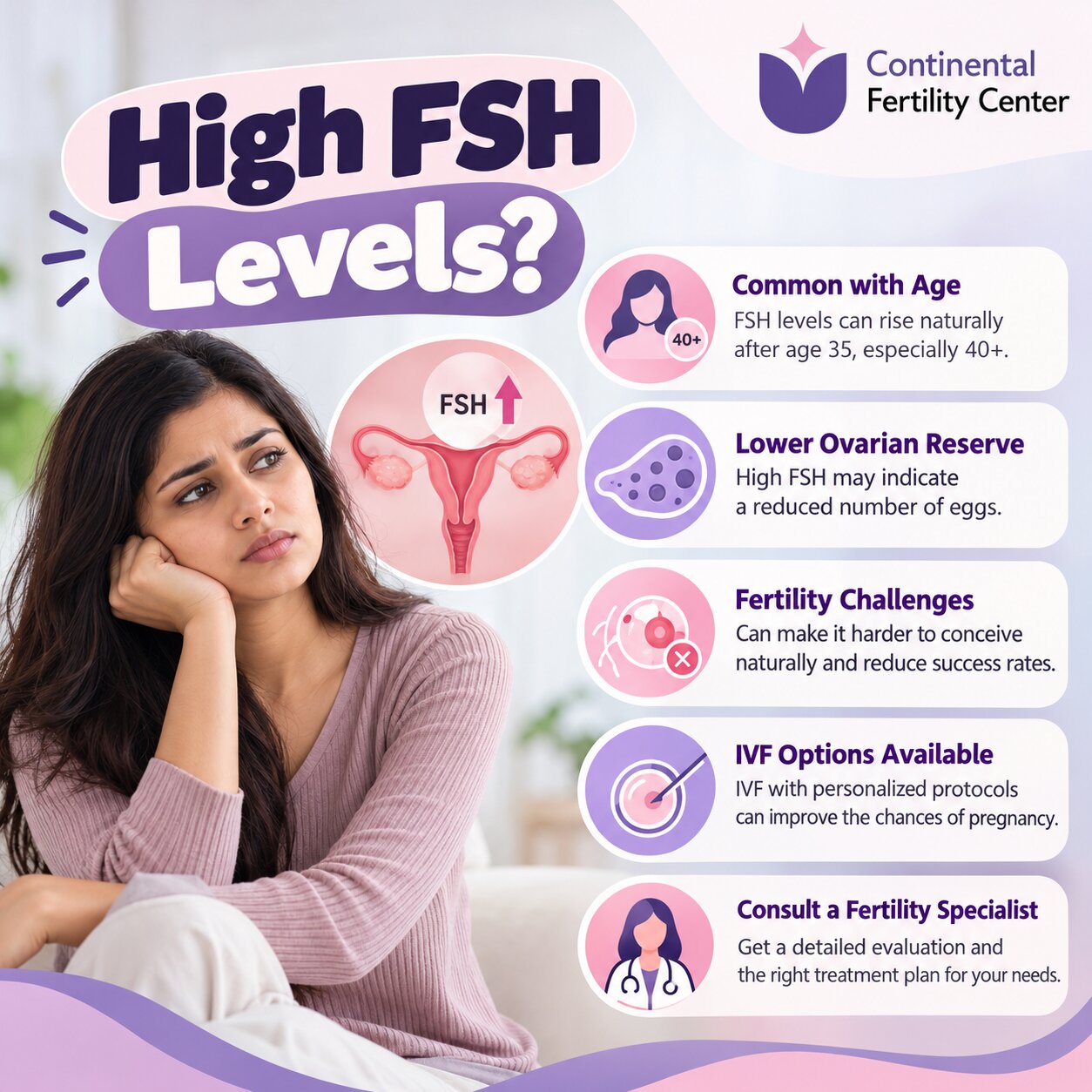
- Age-related changes: Ovarian reserve naturally declines as women get older.
- Reduced ovarian reserve: The ovaries may have fewer remaining eggs.
- Premature ovarian insufficiency: Ovarian function may decline before the age of 40.
- Genetic conditions: Certain genetic factors can affect ovarian function.
- Medical treatments: Chemotherapy, radiation, or some ovarian surgeries may affect egg supply.
High FSH should always be assessed alongside other clinical findings rather than treated as a diagnosis on its own.
What Are the Symptoms of High FSH in Women?
High FSH symptoms in women are not always noticeable. Some women discover elevated levels only when undergoing fertility testing.
Possible associated signs include:
- Irregular or missed menstrual periods
- Difficulty conceiving
- Hot flashes or night sweats
- Vaginal dryness
- Changes in menstrual cycle patterns
These symptoms can have several causes, so hormone testing and medical evaluation are important for identifying the underlying issue.
How Do High FSH Levels Affect Fertility?
The relationship between high FSH and fertility depends on ovarian reserve, age, egg quality, and overall reproductive health. Elevated FSH may indicate that the ovaries have a reduced response to stimulation during fertility treatment.
Women with high FSH levels and pregnancy concerns may require additional tests, such as anti-Müllerian hormone (AMH) testing, an antral follicle count through ultrasound, and other hormone assessments.
Importantly, high FSH does not independently determine whether natural conception or pregnancy through IVF is possible.
Can IVF Help Women With High FSH Levels?
IVF may be an option for some women with elevated FSH, depending on their ovarian function and overall fertility assessment. During IVF, fertility medicines stimulate the ovaries to develop follicles, and mature eggs are collected for fertilization in a laboratory.
High FSH and IVF success are influenced by several factors, including age, egg quality, ovarian response, and the number of eggs available. Some women may respond to stimulation, while others may produce fewer eggs than expected.
A fertility specialist can explain realistic expectations and discuss whether IVF or another reproductive option is appropriate.
What Are the Treatment Options for High FSH?
High FSH treatment options focus on understanding the underlying cause and developing an appropriate fertility plan. Depending on individual circumstances, these may include:
- Personalized fertility monitoring: Tracking ovarian function and menstrual patterns.
- IVF treatment: Considering ovarian stimulation and assisted reproduction when suitable.
- Lifestyle support: Maintaining balanced nutrition, regular physical activity, and avoiding smoking.
- Specialist counselling: Discussing treatment expectations and alternative reproductive options when needed.
There is no proven treatment that reliably reverses age-related ovarian reserve decline or guarantees normal FSH levels. Treatment should focus on the patient's reproductive goals rather than lowering a hormone number alone.
Why Choose Continental Fertility Center, Hyderabad?
Choosing the right fertility center is an important step towards informed reproductive care. Continental Fertility Center offers individualized fertility evaluations, specialist consultations, diagnostic support, and personalized treatment planning.
Continental Hospitals is accredited by the National Accreditation Board for Hospitals and Healthcare Providers (NABH) and the National Accreditation Board for Testing and Calibration Laboratories (NABL). These accreditations reflect established standards for healthcare quality, patient safety, and laboratory testing.
Patients benefit from a multidisciplinary approach, modern clinical facilities, and guidance tailored to their fertility needs.
When Should You Consult a Fertility Specialist?
If you have irregular periods, difficulty conceiving, or test results showing elevated FSH, consult our best fertility specialist in Hyderabad. Early evaluation can help identify the cause and clarify your available options.
At Continental Fertility Center, Hyderabad, our fertility specialists can help you understand your hormone results and explore suitable treatment pathways. If you are experiencing fertility difficulties or concerned about high FSH levels, schedule a consultation for a personalized assessment and guidance.
Conclusion
High FSH levels in women may indicate reduced ovarian reserve, but they do not automatically rule out pregnancy. Understanding the underlying cause, evaluating ovarian function, and considering appropriate treatment options can help women make informed decisions.
With expert guidance and an individualized treatment plan, women can better understand their reproductive health and explore the fertility options that best suit their needs.
Related Blogs:
Frequently Asked Questions
FSH stands for follicle-stimulating hormone. It is produced by the pituitary gland in the brain. This hormone helps the ovaries develop and mature egg-containing follicles. High FSH levels may indicate that the ovaries are responding less strongly to hormonal signals. This can occur when ovarian reserve declines. Ovarian reserve refers to the number of eggs remaining in the ovaries. FSH levels naturally change throughout the menstrual cycle. They are commonly assessed early in the cycle during fertility testing. A high result does not automatically mean that pregnancy is impossible. Age and other hormone levels can affect how the result is interpreted. Doctors may also recommend an AMH test and an antral follicle count ultrasound. A fertility specialist can interpret these findings and recommend appropriate next steps.
High FSH levels can occur for several reasons. One common cause is a decline in ovarian reserve. Ovarian reserve naturally decreases as women age. Some women experience reduced ovarian reserve at a younger age. This may be associated with genetics or family history. Previous ovarian surgery or certain medical treatments can also affect ovarian function. Chemotherapy and radiation may damage ovarian tissue. Premature ovarian insufficiency can cause elevated FSH levels in younger women. Menopause is another natural cause of persistently high FSH. Hormone levels can also vary depending on the menstrual cycle. A single test result may not provide a complete picture of fertility. Doctors may repeat testing and assess other reproductive hormones. Identifying the underlying cause helps guide fertility planning.
High FSH levels can be associated with reduced ovarian reserve. This may mean that fewer eggs are available for fertility treatment. The ovaries may also respond less strongly to stimulation medications. As a result, some women may produce fewer eggs during an IVF cycle. A lower egg yield can affect the number of embryos available for transfer. However, high FSH does not automatically mean infertility. Natural pregnancy may still be possible in some women. Fertility also depends on age, ovulation, sperm quality and reproductive health. The regularity of menstrual cycles can provide additional information. Doctors may recommend AMH testing and an ultrasound to assess ovarian reserve. These findings help estimate the likely response to fertility medication. A fertility specialist can discuss realistic treatment options based on individual results.
Pregnancy may still be possible for some women with high FSH levels. The chances depend on several individual fertility factors. Age is particularly important when assessing egg quality. Ovarian reserve can influence the number of eggs available for fertilization. High FSH may indicate that the ovaries need stronger hormonal stimulation. However, it cannot predict pregnancy outcomes on its own. Some women with elevated FSH conceive naturally. Others may benefit from assisted reproductive treatments. Doctors may evaluate ovulation, fallopian tubes and sperm health. AMH testing and an antral follicle count can provide additional information. A fertility specialist can explain the likely benefits and limitations of available options. Treatment decisions should consider the complete clinical picture. Early consultation may help women make informed decisions about their reproductive goals.
IVF may be possible for some women with high FSH levels. The suitability of treatment depends on ovarian function and overall fertility. High FSH can indicate a reduced response to stimulation medications. This may result in fewer eggs being collected during an IVF cycle. However, the hormone level alone does not determine IVF success. Age, egg quality, sperm quality and embryo development are also important. A fertility specialist may review previous treatment results and hormone tests. An ultrasound can help assess the number of visible antral follicles. The doctor may adjust medication doses according to the individual response. Some women may need more than one treatment cycle. In selected cases, donor eggs may be discussed as an alternative. Each option has different medical, emotional and financial considerations. A personalized fertility consultation can help establish a realistic treatment plan.
Treatment for high FSH depends on the underlying cause and fertility goals. There is no single treatment that reliably lowers FSH and restores ovarian reserve. Doctors first assess hormone levels and reproductive health. Tests may include FSH, AMH and an ultrasound scan. Treatment may focus on improving the chances of pregnancy rather than lowering the hormone number. Some women may try to conceive naturally under medical guidance. Others may consider IVF or other assisted reproductive treatments. Medication protocols can be tailored to the expected ovarian response. Lifestyle measures can support general reproductive health. However, supplements and diets have not been proven to restore lost ovarian reserve. Women with premature ovarian insufficiency may need additional evaluation and care. A fertility specialist can explain the available options and their limitations. Regular follow-up helps guide decisions as fertility needs change.
FSH levels vary according to age and menstrual cycle stage. The laboratory method can also affect the reported reference range. In women who menstruate, FSH is often measured early in the cycle. Doctors commonly assess day two or day three FSH during fertility testing. Results are usually reported in international units per litre. A value considered normal in one laboratory may differ from another laboratory's range. FSH levels are generally higher after menopause. Elevated levels in younger women may require further investigation. Hormonal contraception and certain medications can influence test interpretation. Doctors may review estradiol alongside FSH because it can affect the result. AMH testing and an antral follicle count can provide additional information about ovarian reserve. No single FSH value can accurately predict every woman's fertility. A healthcare professional should interpret the result using age, symptoms and medical history.
Consider seeing a fertility specialist if your FSH result is elevated. Early evaluation can help clarify what the result means for your fertility. Women under 35 are generally advised to seek an assessment after 12 months of trying to conceive. Women aged 35 or older should usually seek assessment after six months. Women over 40 may benefit from more immediate evaluation. You should also seek advice if your periods are irregular or absent. A history of ovarian surgery or cancer treatment may warrant earlier assessment. Repeated pregnancy loss is another reason to discuss fertility with a doctor. The specialist may review FSH, AMH and other relevant hormone tests. An ultrasound may be used to assess ovarian reserve. Your partner may also need a fertility assessment. The doctor can explain natural conception, IVF and other appropriate options. An individualized plan can help you make informed decisions about your next steps.