

Low AMH vs. Egg Quality: Understanding Their Role in IVF Success
Whenever couples commence fertility treatments, they often find themselves perplexed by two terms, namely, Low AMH vs Egg Quality. AMH or Anti-Müllerian Hormone helps measure the ovarian reserve, while egg quality is determined by different factors, including age and overall reproductive wellness. Knowing the difference can help them set realistic standards before IVF treatment.
The terms Low AMH and Egg Quality cannot be used interchangeably.
A low AMH reading does signify that the number of eggs in the ovaries could have decreased; however, it does not indicate whether the remaining eggs are of good quality. The terms egg quality and ovarian reserve do play a role in determining fertility but refer to two different concepts when it comes to reproduction.
How Does AMH Impact Fertility?
AMH is a hormone secreted by developing follicles in the ovaries. An AMH blood test can help estimate the ovarian reserve, or number of remaining eggs.
Low AMH can indicate:
- A reduced ovarian reserve
- Few eggs available for IVF stimulation
- Less chance of responding to eggs in certain patients
- A shorter reproductive life span
Nevertheless, AMH cannot determine if a woman can conceive by herself or through IVF.
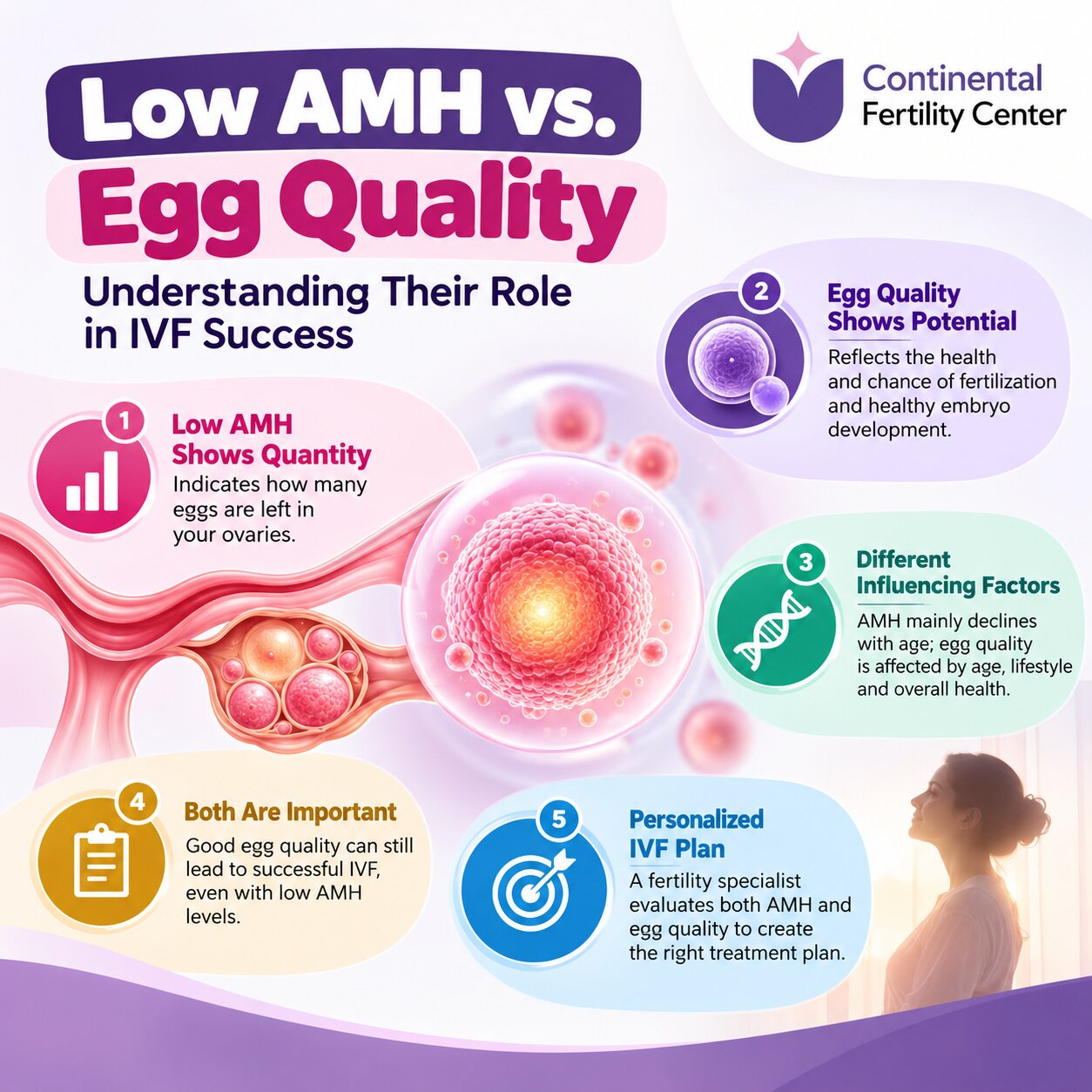
Does Low AMH Indicate Low Egg Quality?
No, low AMH and egg quality are not synonymous.
Low levels of AMH only speak about the quantity of the eggs, not the quality. A person with a low AMH might have the healthy eggs, and the opposite may also hold true.
This is one of the most important distinctions to make when evaluating low AMH vs. egg quality.
What Affects Egg Quality?
Egg quality is determined by many biological factors. Age is the most significant factor influencing egg quality because chromosomal defects in eggs tend to rise with age.
Other factors that may have some influence on reproductive health are:
- Age
- Genetic factors
- Smoking and drinking alcohol
- Certain health conditions
- Any previous ovarian treatments
- General reproductive health
- Lifestyle and nutrition.
At the moment, there is no blood test available that is able to measure egg quality quantitatively.
What Does Low AMH Mean for IVF Success?
When performing low AMH IVF treatment, careful preparations should be done because low ovarian reserve means that fewer eggs will be retrieved after stimulation.
However, the number of eggs retrieved is only one part of the in vitro fertilization process since fertilization, embryo development, the fetus's health, and uterine condition have an impact on the success of IVF as well.
Thus, low AMH and IVF success can’t be perceived as a cause-and-effect relationship.
The Impact of Egg Quality on IVF Outcomes
Egg quality is one of the significant variables in IVF outcomes because it is associated with the ability of eggs to fertilize and develop into healthy embryos.
Low-quality eggs may affect the chances of:
- Successful fertilization
- Successful embryo formation
- Good chromosomal makeup
- Successful implantation of the embryos
- Successful pregnancy
Age is of great importance when it comes to the egg quality aspect in IVF; it must be noted that the outcomes may be quite different individually.
Is it possible to have a low AMH but good egg quality?
Definitely, yes.
A low ovarian reserve does not necessarily mean the complete absence of eggs with a good reproductive potential. The issue with the low AMH is more about the number of eggs rather than the actual egg quality.
Can AMH Levels Help Predict IVF Outcome?
While AMH levels have proven valuable for determining treatment strategies, they are not the only factor that doctors use to forecast the likelihood of success in an IVF procedure.
Along with AMH, practitioners may take into consideration other indicators, such as:
- Age
- Antral follicle count
- Previous IVF results
- Hormonal levels
- Medical history
- Semen analysis
- Physical factors related to the uterus and fallopian tubes
- Embryologic status of developing embryos
Why Go for Continental Fertility Center?
With a detailed assessment at its initial stage rather than depending on a single diagnostic test, fertility treatment at Continental Fertility Center starts. The specialists at the center consider ovarian reserve and reproductive history along with women’s age, hormonal levels, and other factors that may affect their fertility before coming up with a personalized infertility treatment plan.
Continental Hospitals adheres to the accepted quality framework as well as patient safety norms in healthcare and is accredited by NABH and JCI. The hospital also has up-to-date laboratories, surgeries, and diagnostic facilities that make it possible to provide comprehensive infertility treatment.
The patients can take advantage of:
- Personalized infertility assessment
- Specialization in reproductive and infertility treatment
- Up-to-date diagnostic equipment
- Tailored IVF programs
- Embryology and laboratory assistance
- Joint healthcare
- Proper counseling for patients
Those patients who are searching for the most proper hospital in Hyderabad regarding the infertility treatment should consider the importance of specialists’ experience, presence of quality equipment, laboratory support, and availability of diagnostic services at the center.
When Should You Consult a Fertility Specialist?
If you have been diagnosed with low AMH, have been trying to conceive without success, or are considering IVF, consulting a fertility specialist can help you understand your individual reproductive potential.
If you are struggling with infertility or have concerns about low AMH vs. egg quality, consult our best fertility specialist in Hyderabad at Continental Fertility Center for a personalized fertility assessment.
Conclusion
Understanding low AMH vs. egg quality can help remove a common misconception in fertility treatment. Low AMH mainly indicates a lower ovarian reserve and does not automatically mean that the available eggs have poor quality.
Egg quality is influenced by several factors, particularly age, and cannot be determined by AMH alone. For this reason, fertility treatment should be planned after considering ovarian reserve, egg quality-related factors, reproductive history, and overall fertility health.
A personalized assessment can help determine the most appropriate fertility treatment approach and provide a clearer understanding of your IVF options.
Related Blogs:
Frequently Asked Questions
AMH stands for Anti-Müllerian Hormone. It is produced by cells in developing ovarian follicles. An AMH test can provide an estimate of ovarian reserve. Ovarian reserve refers to the remaining supply of eggs. AMH levels can vary from one woman to another. Age can also influence AMH levels and ovarian reserve. A low AMH level may indicate reduced ovarian reserve. However, low AMH does not directly measure egg quality. AMH also cannot predict pregnancy on its own. Doctors consider AMH along with other fertility tests. These may include antral follicle count and hormone testing. Egg quality is influenced strongly by factors such as age. A fertility specialist can interpret AMH results in context.
Low AMH generally indicates a lower ovarian reserve. It may mean fewer eggs are available for stimulation during IVF. Low AMH does not mean that pregnancy is impossible. Women with low AMH can still produce usable eggs. The response to IVF medicines may vary between individuals. Age remains an important factor in fertility outcomes. Low AMH is different from poor egg quality. AMH mainly provides information about egg quantity. It does not directly assess whether an egg is genetically normal. Doctors may use AMH to plan ovarian stimulation. Other tests can provide additional information about ovarian reserve. A fertility specialist can explain what a specific AMH result means. Treatment decisions should be based on the complete fertility assessment.
Low AMH mainly reflects reduced ovarian reserve. It does not directly indicate poor egg quality. Egg quality is influenced significantly by a woman's age. A woman with low AMH may still have good-quality eggs. However, fewer eggs may be available during an IVF cycle. This can reduce the number of embryos available for selection. The number of eggs and their quality are separate fertility factors. AMH cannot determine the genetic health of an individual egg. Embryo development can provide additional information during IVF. Chromosomal abnormalities are more closely associated with maternal age. Doctors consider AMH together with age and other fertility findings. Low AMH should not automatically be interpreted as poor egg quality. A personalized fertility evaluation can provide a clearer picture.
Egg quality is strongly influenced by age and cannot be completely changed. There is no proven treatment that can reverse age-related egg aging. However, overall reproductive health can still be supported. A balanced diet can help support general health and wellbeing. Regular physical activity may also support overall health. Avoiding smoking is important for reproductive health. Excessive alcohol consumption may also negatively affect fertility. Managing certain medical conditions can be beneficial before IVF. Doctors may recommend supplements in specific situations. Supplement use should be based on professional medical advice. Lifestyle changes cannot guarantee better egg quality. Fertility treatment should consider both egg quantity and quality. A specialist can recommend appropriate options based on individual factors.
IVF can be considered for women with low AMH. Low AMH does not automatically mean that IVF will fail. The main concern may be a lower response to ovarian stimulation. This can result in fewer eggs being retrieved during treatment. However, even a small number of eggs may produce viable embryos. Age is an important factor when assessing IVF outcomes. Egg quality and embryo development also influence treatment results. Doctors may adjust stimulation medicines based on ovarian reserve. Other fertility factors are considered before starting an IVF cycle. Sperm quality can also influence embryo development. The uterus and overall reproductive health are also evaluated. A fertility specialist can create an individualized treatment plan. Early consultation may help determine suitable fertility options.
AMH and egg quality provide different information about fertility. AMH mainly helps estimate the number of remaining eggs. Egg quality refers to the developmental and genetic potential of an egg. Neither factor should be considered alone during IVF planning. A low AMH level may indicate fewer eggs available for retrieval. Egg quality can influence fertilization and embryo development. Age is an important factor associated with egg quality. A woman may have low AMH while still producing a good-quality egg. Another woman may have more eggs but age-related changes in egg quality. Doctors therefore consider multiple fertility factors together. These may include age, AMH, antral follicle count and medical history. IVF results also depend on sperm and embryo-related factors. A complete fertility assessment gives a more meaningful picture.
There is no single AMH level that guarantees successful IVF. AMH levels can vary naturally between women. Laboratory methods and reference ranges can also differ. AMH is mainly used to estimate ovarian reserve. It can help doctors anticipate the response to stimulation medicines. A higher AMH does not necessarily mean better egg quality. Similarly, a low AMH does not mean that pregnancy is impossible. Age remains an important factor when discussing IVF outcomes. Doctors may also assess antral follicle count using ultrasound. Previous IVF response can provide useful information for treatment planning. The overall fertility history is considered alongside AMH results. Therefore, AMH should not be interpreted as a standalone success predictor. A fertility specialist can explain the result based on individual circumstances.
A fertility consultation can help when pregnancy has not occurred as expected. Women with a known low AMH may also benefit from early evaluation. Women concerned about declining fertility can discuss testing with a specialist. Age is an important consideration when deciding when to seek help. A specialist can review menstrual and reproductive history. Tests may be recommended to assess ovarian reserve. These can include AMH testing and antral follicle count. Other fertility tests may be advised depending on individual circumstances. Semen analysis may also be recommended for the male partner. The specialist can explain how egg quantity differs from egg quality. IVF or other fertility treatments may be discussed when appropriate. Early evaluation can help patients understand their available options. A personalized plan can then be developed based on the complete assessment.