
PRP IVF Treatment Success Rate: What the Evidence Says and What Couples Should Know
Could PRP IVF offer another option for couples facing fertility challenges? PRP IVF is an emerging fertility treatment that uses platelet-rich plasma, commonly known as PRP, which is prepared from a person's own blood. Researchers have studied its possible role in improving the reproductive environment, particularly in women with certain fertility concerns.
PRP IVF may be discussed in situations such as reduced ovarian reserve, previous poor response to fertility treatment, repeated IVF difficulties, or certain endometrial problems. However, an important question remains: Does PRP actually improve IVF success rates? Current research is promising in some areas, but the evidence is still developing. PRP should therefore be considered an additional or experimental approach in selected cases rather than a guaranteed way to improve IVF outcomes.
How Does PRP Treatment for IVF Work?
What happens during PRP treatment for IVF? PRP is prepared from the patient's own blood. The blood is processed to concentrate platelets and growth factors. Depending on the fertility concern being treated, the prepared PRP may be introduced into the uterus or, in selected cases, the ovaries.
The idea behind PRP (platelet-rich plasma) fertility treatment is that growth factors released by platelets may support tissue repair and cellular activity. Researchers are investigating whether this could improve the ovarian or uterine environment.
However, PRP IVF does not create new eggs, reverse age-related fertility decline, or guarantee embryo implantation.
Can PRP Improve IVF Success Rates?
Does PRP for IVF success have strong scientific evidence? This is one of the most important questions couples should ask before considering the treatment.
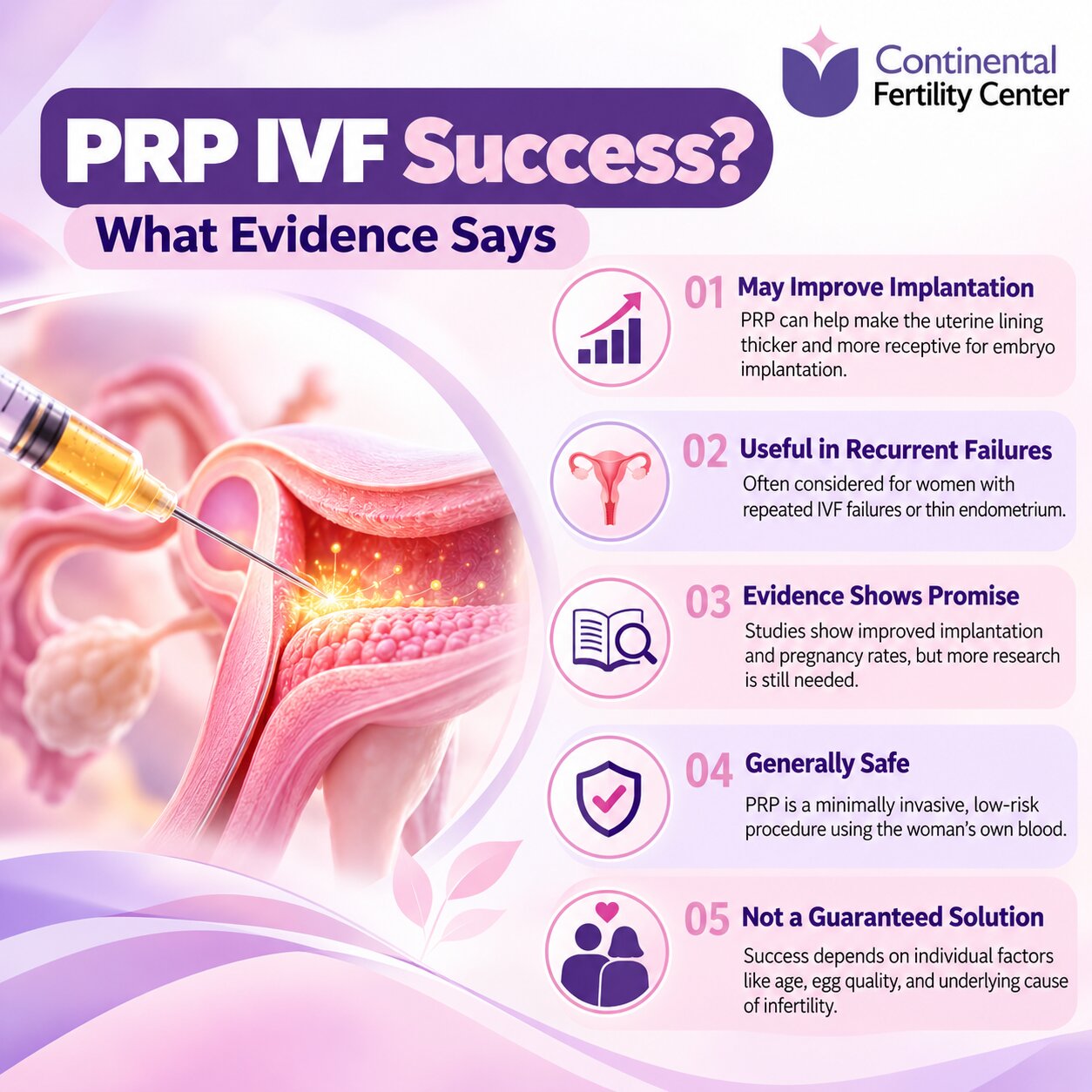
Some clinical studies and reviews have reported improvements in certain fertility outcomes following PRP treatment. These may include changes in ovarian response, endometrial thickness, embryo-related outcomes, or pregnancy rates in selected groups.
However, research findings are not completely consistent. Studies differ in patient selection, PRP preparation methods, treatment protocols, and outcome measurements. Some studies have shown potential benefits, while others have found limited or uncertain improvement.
Therefore, the PRP and IVF success rate cannot be predicted for every patient.
Which Couples May Be Considered for PRP IVF?
Could PRP be useful for everyone undergoing IVF? No. PRP for fertility is generally considered on an individual basis.
A fertility specialist may discuss PRP in selected situations such as:
- Reduced ovarian reserve or poor ovarian response
- Previous IVF cycles with poor response
- Certain cases of thin endometrium
- Repeated implantation difficulties
- Selected fertility problems where conventional approaches have not produced the expected results
The suitability of PRP depends on age, ovarian reserve, medical history, previous IVF outcomes, and the underlying fertility diagnosis.
What Is PRP Ovarian Rejuvenation?
Can PRP ovarian rejuvenation restore ovarian function completely? There is currently no strong evidence to suggest that PRP can reverse the natural effects of ovarian aging.
PRP ovarian rejuvenation is a term used for procedures in which PRP is introduced into the ovaries with the aim of influencing ovarian activity. Some early research has explored whether this may affect ovarian markers or response to stimulation.
However, the treatment remains an area of ongoing research. Couples should understand that PRP cannot reliably increase egg quality or guarantee more mature eggs.
What Are the Possible Benefits of PRP Treatment for Infertility?
Why is PRP treatment for infertility being studied? Researchers are interested in the biological effects of platelet-derived growth factors and their possible role in tissue repair.
Potential areas being investigated include:
- Supporting the endometrial environment
- Improving response to ovarian stimulation in selected patients
- Supporting reproductive tissue healing
- Potentially improving certain IVF outcomes in specific groups
These possible benefits should be discussed carefully with a fertility specialist because the evidence is still evolving.
Is PRP IVF Proven to Increase IVF Success?
Is PRP IVF a proven method for increasing the chances of having a baby? At present, it would be inaccurate to describe PRP as a guaranteed IVF success treatment.
The available evidence suggests potential benefits in selected patients, but more high-quality research is needed to establish who benefits most, which PRP method is most effective, and how much it can influence live birth rates.
Couples should therefore avoid choosing PRP based only on claims of dramatically higher success rates.
What Should Couples Ask Before Choosing PRP IVF?
Before undergoing PRP IVF, couples can discuss these important questions with their fertility specialist:
- Why is PRP being recommended in my case?
- What fertility problem is the treatment intended to address?
- What does current evidence say about my specific condition?
- Could conventional IVF treatment be sufficient?
- What are the possible risks and limitations?
- How will my treatment response be monitored?
- What other fertility treatment options are available?
Having a clear discussion can help couples make an informed decision.
Why Choose Continental Hospitals for Fertility Care?
Why is specialist guidance important when considering PRP IVF? Fertility treatment requires careful assessment because every couple has different medical and reproductive factors.
Continental Hospitals, Hyderabad, provides comprehensive fertility and reproductive care supported by specialist expertise, advanced diagnostic facilities, modern clinical infrastructure, and multidisciplinary medical services. The hospital follows established quality and patient safety standards and holds recognized national and international healthcare accreditations, including JCI and NABH, reflecting its commitment to quality healthcare and patient safety.
At Continental Fertility Centre, treatment decisions can be planned according to individual fertility factors, previous treatment history, investigations, and clinical requirements. Emerging treatments such as PRP can be discussed in the context of available scientific evidence rather than as a guaranteed solution.
What Should Couples Remember About PRP IVF?
- PRP uses platelet-rich plasma prepared from the patient's own blood.
- PRP is being studied for different fertility applications.
- Research has reported potential benefits in selected patients.
- Evidence about PRP and IVF success rates remains limited and inconsistent.
- PRP cannot guarantee pregnancy or live birth.
- PRP does not reverse natural egg aging.
- Treatment suitability should be determined by a fertility specialist.
- Couples should understand both potential benefits and limitations before treatment.
Conclusion
Can PRP IVF improve fertility outcomes? It may have potential for selected patients, but current evidence does not support presenting it as a guaranteed method for improving IVF success. PRP fertility treatment remains an evolving area of reproductive medicine, and further high quality research is needed.
If you are considering PRP for IVF success, have experienced previous IVF difficulties, or want to understand whether PRP treatment for Infertility may be appropriate for you, consult our best fertility specialist in Hyderabad at Continental Fertility Centre, Continental Hospitals, Hyderabad, for personalized evaluation and evidence-based fertility guidance.
Related Blogs:
PRP IVF Treatment in Hyderabad: Can Platelet-Rich Plasma Improve Fertility Outcomes?
Frequently Asked Questions
PRP IVF treatment uses platelet-rich plasma during fertility care. PRP is prepared from a small sample of the patient's own blood. The blood is processed to concentrate platelets and growth factors. These substances may support tissue repair and healing. PRP has been studied for different reproductive applications. It may be considered for the ovaries or uterine lining in selected patients. Some fertility centers use it as an additional treatment alongside IVF. The aim is to potentially improve the reproductive environment. PRP does not replace standard IVF procedures. Its effectiveness is still being studied in clinical research. Results can vary depending on the patient's fertility condition. A fertility specialist can explain whether PRP may be appropriate.
PRP may improve some IVF outcomes in selected patients. Research has explored PRP for ovarian and endometrial conditions. Some studies have reported improvements in certain fertility measures. However, evidence for improved live birth rates remains uncertain. PRP should not be considered a guaranteed way to increase IVF success. Treatment outcomes depend on several individual fertility factors. These factors include age, ovarian reserve, egg quality, and embryo quality. Uterine health can also influence implantation and pregnancy. The cause of infertility is another important consideration. PRP is generally considered an additional approach to fertility treatment. More high-quality research is needed to confirm its benefits. A fertility specialist can discuss the potential advantages and limitations.
There is no single proven PRP IVF success rate for all patients. Research findings have varied between studies and patient groups. Some studies have reported improvements in reproductive outcomes. Other studies have found limited or uncertain benefits. Live birth rates are particularly important when assessing IVF success. Current evidence does not establish a guaranteed increase in live birth rates with PRP. Success also depends on the underlying cause of infertility. Patient age and ovarian reserve can strongly influence IVF outcomes. Embryo quality and uterine health are also important factors. The number of previous IVF attempts may affect the treatment plan. PRP should therefore not be judged using one fixed success percentage. Your fertility specialist can provide a more individualized assessment.
PRP may be considered for selected patients with specific fertility concerns. Research has examined its use in women with poor ovarian response. It has also been studied in patients with a thin endometrium. Some studies have evaluated PRP after previous unsuccessful fertility treatments. However, PRP may not benefit every patient undergoing IVF. Age and ovarian reserve should be assessed before treatment decisions are made. Previous IVF outcomes may also provide important information. The underlying cause of infertility needs careful evaluation. A fertility specialist may recommend blood tests, scans, or other investigations. PRP should be considered only when the potential benefits are relevant. It should not replace established fertility treatments. Couples should discuss the available evidence before choosing PRP. Individual fertility assessment is important for making an informed decision.
PRP has been investigated as a possible approach to ovarian function. Some research has explored whether PRP may affect ovarian response. However, evidence that PRP reliably improves egg quality is limited. Egg quality is strongly influenced by factors such as age. Ovarian reserve can also affect fertility treatment outcomes. PRP should not be presented as a proven method to improve egg quality. Studies have reported different findings regarding ovarian response. More research is needed to understand which patients might benefit. The number of eggs retrieved does not always predict live birth. Embryo development and genetic factors also influence IVF outcomes. A fertility specialist can assess ovarian reserve and reproductive health. This assessment can help determine appropriate treatment options. Couples should discuss realistic expectations before considering PRP.
PRP has been studied as a possible treatment for endometrial concerns. Researchers have explored its use in patients with a thin uterine lining. The aim is to potentially support endometrial development before embryo transfer. Some studies have reported improvements in endometrial thickness. However, increased thickness does not automatically mean successful implantation. Implantation depends on several factors involving the embryo and uterus. Embryo quality and genetic health are important considerations. Uterine anatomy and hormonal factors can also affect implantation. Evidence about PRP improving live birth outcomes remains uncertain. PRP should therefore not be considered a guaranteed implantation treatment. Your fertility specialist can assess the uterine lining before recommending additional treatment. The decision should be based on individual circumstances and available evidence.
PRP is prepared using the patient's own blood. This may reduce certain concerns associated with donor-derived biological material. However, PRP is still a medical procedure with potential risks. Blood collection can cause temporary discomfort, bruising, or dizziness. Procedures involving the reproductive organs may have additional risks. These can include pain, bleeding, or infection. The safety of PRP may also depend on the technique used. Long-term safety evidence in fertility treatment remains limited. Evidence regarding pregnancy and birth outcomes is still developing. PRP should therefore be discussed with a qualified fertility specialist. Patients should provide their complete medical and fertility history. Proper clinical and sterile procedures are important. The potential benefits and risks should be considered before treatment.
PRP is not a replacement for conventional IVF treatment. IVF is an established assisted reproductive technology for infertility. PRP is an additional approach that continues to be studied. The two approaches have different roles in fertility care. IVF involves ovarian stimulation, egg retrieval, fertilization, and embryo transfer. PRP may be considered for selected ovarian or endometrial concerns. Current evidence does not show that PRP is better than standard IVF. IVF outcomes depend on factors such as age and embryo quality. Ovarian reserve and sperm quality can also influence treatment outcomes. Uterine health may affect implantation and pregnancy. Couples should be cautious about claims of guaranteed success with PRP. A fertility specialist can explain whether PRP has a potential role in an individual IVF plan. Treatment decisions should be based on medical evaluation and evidence.