
Vitrification in IVF: Process, Benefits and Egg and Embryo Freezing Explained
Vitrification in IVF is an advanced freezing technique that helps preserve eggs and embryos for future fertility treatment. It uses an ultra rapid freezing process to protect reproductive cells from damage caused by ice crystal formation. This technique has become an important part of modern IVF treatment, offering more flexibility for individuals and couples planning a pregnancy.
At Continental Fertility Center, fertility preservation and IVF treatment are planned according to each patient's reproductive health and personal goals. Understanding the vitrification process, its benefits, and the differences between egg freezing and embryo freezing can help patients make informed decisions about their fertility journey.
What Is Vitrification in IVF?
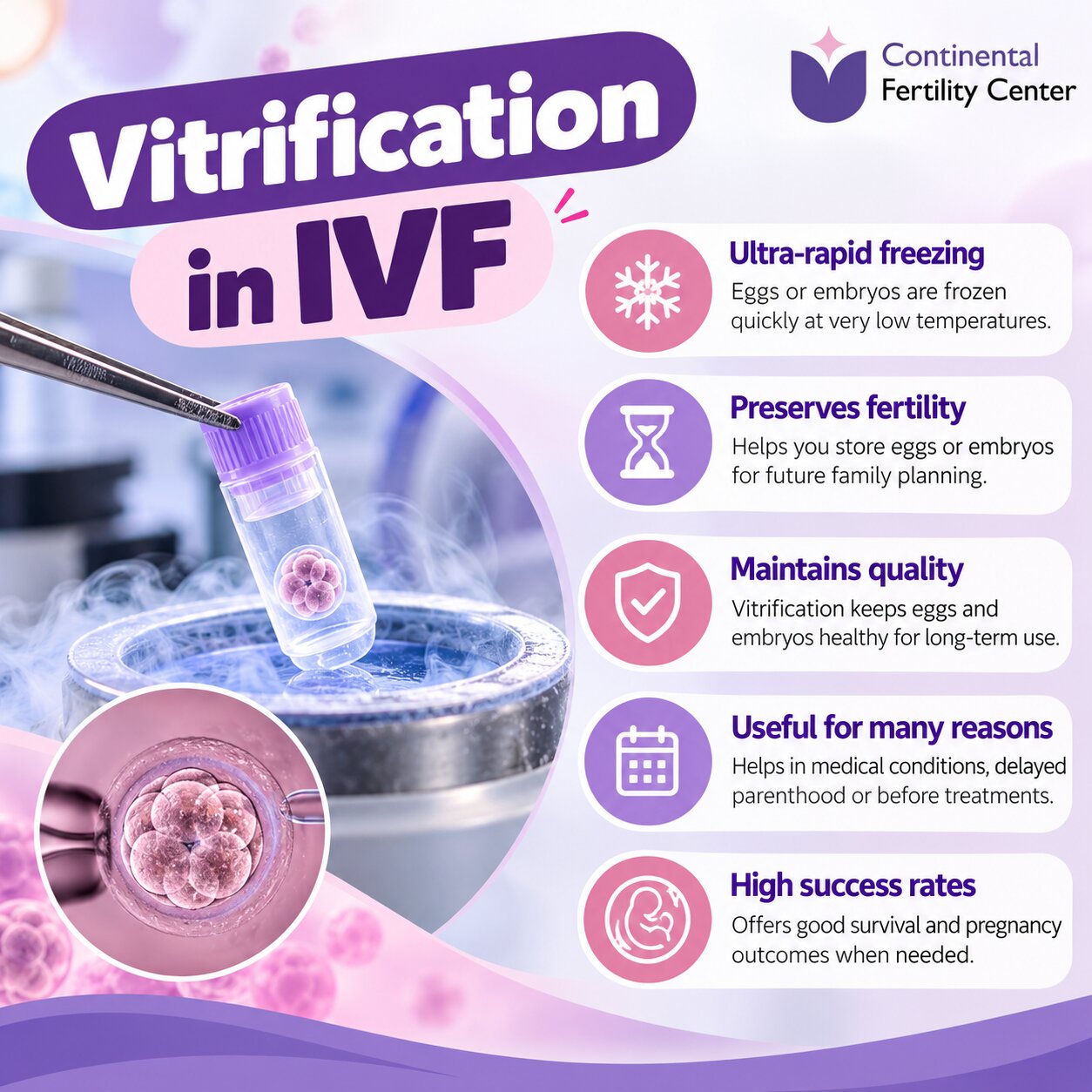
Vitrification in IVF is a specialized freezing technique that converts eggs or embryos into a glass-like state without allowing harmful ice crystals to form. Unlike traditional slow freezing, vitrification uses rapid cooling with carefully selected cryoprotective solutions to protect cells during freezing.
The frozen eggs or embryos are stored in liquid nitrogen at very low temperatures until they are needed for future fertility treatment.
How Does the Vitrification Process Work?
The vitrification process involves several carefully controlled laboratory steps to preserve eggs or embryos.
- Fertility assessment: The specialist evaluates reproductive health and discusses whether egg or embryo freezing is suitable.
- Egg retrieval or embryo development: Eggs are collected after ovarian stimulation. For embryo freezing, eggs are fertilized with sperm and allowed to develop in the laboratory.
- Cryoprotectant preparation: Special solutions help protect the cells during rapid cooling.
- Rapid freezing: Eggs or embryos are cooled quickly using the vitrification technique.
- Long-term storage: The frozen material is stored under controlled conditions until future use.
- Warming and treatment: When needed, the eggs or embryos are carefully warmed for fertilization or embryo transfer, depending on the treatment plan.
What Is the Difference Between Egg Freezing and Embryo Freezing?
Both methods help preserve fertility, but they serve different needs.
Egg Freezing: Egg vitrification preserves unfertilized eggs for future use. It may be suitable for women who want to delay pregnancy, preserve fertility before certain medical treatments, or keep future reproductive options open without fertilizing eggs immediately.
Embryo Freezing: Embryo vitrification involves freezing fertilized eggs that have developed into embryos. It is commonly used during IVF when suitable embryos are available for transfer in a future cycle.
The choice depends on personal circumstances, reproductive plans, medical history, and whether sperm is available for fertilization.
What Are the Benefits of Vitrification in IVF?
Vitrification in IVF offers several potential benefits for patients undergoing fertility treatment.
- Improved cell preservation: Rapid cooling helps reduce ice crystal formation that can damage eggs and embryos.
- Flexible treatment planning: Frozen eggs and embryos can be used in future treatment cycles.
- Fertility preservation: Egg freezing may help preserve reproductive options before certain medical treatments or when pregnancy is being postponed.
- Support for IVF planning: Embryo freezing allows suitable embryos to be stored for later transfer.
- Reduced need for repeated procedures: Frozen embryos from a previous cycle may be available for future transfers without repeating egg retrieval.
Although vitrification has improved freezing outcomes, successful warming, fertilization, implantation, and pregnancy cannot be guaranteed.
Who Should Consider Vitrification in IVF?
Vitrification may be discussed with women planning to delay pregnancy, patients undergoing IVF, individuals preparing for treatments that may affect fertility, and couples who have suitable embryos remaining after an IVF cycle.
A fertility specialist can assess ovarian reserve, age, reproductive health, treatment goals, and the expected benefits and limitations before recommending fertility preservation.
Why Choose Continental Fertility Center?
Choosing the right fertility center is an important step in your treatment journey. Continental Fertility Center offers personalized fertility assessment, specialist guidance, IVF treatment planning, and laboratory support to help patients understand their available options.
Continental Hospitals holds NABH and NABL accreditations, reflecting established standards for healthcare quality, patient safety, and laboratory quality management.
Patients can benefit from:
- Individualized fertility treatment plans
- Specialist consultations and reproductive health assessments
- Advanced fertility laboratory services
- Guidance on egg freezing and embryo freezing
- Support throughout IVF treatment and follow-up
Continental Hospitals is committed to patient-centered care, clinical quality, and informed treatment decisions.
When Should You Consult a Fertility Specialist?
If you are planning to delay pregnancy, considering fertility preservation, or undergoing IVF treatment, consult a fertility specialist to understand whether vitrification is suitable for you. Early evaluation can help you explore available options according to your reproductive health and future goals.
Conclusion
Vitrification in IVF has made egg and embryo freezing an important part of modern fertility care. By using rapid cooling to help protect reproductive cells, this technique provides greater flexibility for future fertility treatment. However, outcomes depend on factors such as age, egg quality, embryo development, and individual medical conditions.
If you are considering egg freezing, embryo freezing, or fertility preservation, consult our best fertility specialist in Hyderabad at Continental Fertility Center, Hyderabad, for personalized guidance and treatment planning.
Frequently Asked Questions
Vitrification is a rapid freezing technique used in IVF treatment. It helps preserve eggs, embryos, and other reproductive cells. The process uses special solutions called cryoprotectants. These solutions help protect cells during freezing. The cells are cooled extremely quickly to prevent ice crystal formation. Ice crystals can damage delicate reproductive cells. Vitrification helps reduce this risk. It is commonly used in modern fertility clinics. Frozen eggs and embryos can be stored for future use. They may be thawed when the patient is ready for treatment. Vitrification can support fertility preservation and IVF planning. However, not every frozen egg or embryo survives warming. Outcomes depend on several individual factors. A fertility specialist can explain whether vitrification is suitable for your treatment.
Vitrification begins with preparing the eggs or embryos for freezing. The cells are exposed to carefully controlled cryoprotectant solutions. These solutions help protect them from freezing-related damage. The cells are then cooled at an extremely rapid rate. This process turns the surrounding solution into a glass-like state. It prevents the formation of harmful ice crystals. The frozen cells are stored in liquid nitrogen at very low temperatures. They remain preserved until they are needed for treatment. When required, the cells are carefully warmed. Protective solutions are removed through a controlled process. The embryology team then assesses their survival and condition. Eggs that survive warming may be used for fertilization. Embryos that survive warming may be considered for transfer. The procedure is performed by trained embryologists using specialized laboratory equipment.
Vitrification helps preserve eggs and embryos for future fertility treatment. It allows patients to store reproductive cells instead of using them immediately. Frozen embryos may be transferred during a later treatment cycle. Egg freezing can help preserve fertility for personal or medical reasons. Vitrification is faster than traditional slow-freezing methods. Rapid cooling helps reduce the risk of damaging ice crystals. The technique is widely used in modern IVF laboratories. It can provide flexibility when planning embryo transfer. It may also help preserve surplus embryos from an IVF cycle. Patients can discuss future treatment options with their fertility specialist. However, freezing does not guarantee successful fertilization or pregnancy. Results depend on age, egg quality, embryo quality, and other factors. The specialist will recommend an appropriate preservation plan based on individual needs.
Egg vitrification is a technique used to freeze and preserve unfertilized eggs. It is also known as egg freezing. The process usually begins with fertility assessment and ovarian stimulation. Medications help the ovaries develop multiple mature eggs. The eggs are collected through a medical procedure. Mature eggs are selected for vitrification in the laboratory. Cryoprotectant solutions help protect the eggs during rapid cooling. The eggs are then stored in liquid nitrogen. They can remain stored under appropriate conditions until needed. When the patient decides to use them, the eggs are carefully warmed. Surviving eggs can be fertilized using an appropriate IVF technique. The resulting embryos may be cultured and assessed before transfer. Egg freezing may offer future reproductive options but cannot guarantee a baby. Age at the time of freezing is an important factor influencing the chances of success.
Embryo vitrification is the rapid freezing of embryos created during IVF. Eggs are first fertilized with sperm in the laboratory. The resulting embryos are monitored as they develop. Suitable embryos may be selected for freezing. Special cryoprotectant solutions help protect the embryos during the process. The embryos are cooled rapidly to reduce ice crystal formation. They are then stored in liquid nitrogen. Frozen embryos can be used in a future treatment cycle. Before transfer, the embryos are carefully warmed. The embryology team checks whether they have survived the warming process. Suitable surviving embryos may be transferred into the uterus. Embryo vitrification can help patients avoid using all suitable embryos in one cycle. It may also support fertility preservation before certain medical treatments. The likelihood of pregnancy depends on embryo quality, patient age, and other clinical factors.
Vitrification offers several benefits in modern fertility treatment. It helps preserve eggs and embryos for future use. Rapid cooling reduces the risk of damaging ice crystals. It generally provides better survival rates than older slow-freezing methods for human eggs and embryos. It gives patients more flexibility when planning IVF treatment. Frozen embryos can be transferred in a later cycle when clinically appropriate. Egg freezing may help preserve reproductive options for the future. Vitrification can also support fertility preservation before some medical treatments. It allows suitable surplus embryos to be stored rather than discarded. The technique is widely used in assisted reproductive technology. However, the number of eggs or embryos available for freezing can vary. Some cells may not survive the warming process. Freezing does not guarantee implantation, pregnancy, or live birth. A fertility specialist can explain the expected benefits based on your circumstances.
Vitrification is an established technique used in fertility laboratories. It is widely used to preserve human eggs and embryos. The rapid-freezing process helps limit damage caused by ice crystal formation. Specialized cryoprotectants protect cells during cooling and warming. The procedure requires trained embryologists and carefully controlled laboratory conditions. Most appropriately selected eggs and embryos can survive the process, although survival is not guaranteed. Some cells may be damaged during freezing or warming. The outcome depends on cell quality and laboratory procedures. Stored material must be monitored and handled according to established protocols. The long-term storage process also requires reliable identification and tracking systems. Vitrification itself does not guarantee a successful pregnancy. Individual risks and expected outcomes should be discussed before treatment. A fertility specialist can explain the procedure and address your concerns.
Eggs and embryos can remain frozen for many years under appropriate storage conditions. They are preserved in liquid nitrogen at extremely low temperatures. These conditions greatly limit biological activity. The duration of storage alone does not necessarily determine whether the cells remain usable. Proper laboratory monitoring and secure storage are essential. The survival of eggs and embryos after warming can vary. The quality of the cells before freezing also matters. Age at egg collection can influence future reproductive outcomes. Storage periods may be subject to local laws and clinic policies. Consent requirements and renewal procedures may also apply. Patients should discuss storage duration with their fertility center. They should keep their contact details and consent records updated. Before using frozen material, the clinic will explain the warming and treatment process. A specialist can help plan the next steps according to individual circumstances.
Vitrification can help preserve eggs and embryos for later IVF treatment. Its rapid-freezing method generally improves cell survival compared with traditional slow freezing. This can increase the number of eggs or embryos available after warming. Frozen embryo transfer may offer flexibility in choosing the timing of treatment. However, vitrification does not directly guarantee higher IVF success for every patient. Success depends on several important factors. These include the patient's age and reproductive health. Egg quality and embryo development also influence outcomes. Sperm quality and the condition of the uterus may play a role. The number of eggs or embryos available can affect treatment options. Some eggs or embryos may not survive warming. Even a good-quality embryo may not implant successfully. A fertility specialist can discuss realistic success rates for your situation. Treatment decisions should be based on individual assessment and evidence-based fertility care.