
Failed IUI 3 Times? When Is It Time to Move to IVF?
Experiencing repeated unsuccessful fertility treatments can be emotionally challenging for couples trying to conceive. Intrauterine Insemination (IUI) is often recommended as an initial fertility treatment because it is less invasive and may be suitable for couples with certain fertility conditions. However, when pregnancy does not occur after multiple attempts, couples may begin wondering whether it is time to consider IVF.
Failed IUI treatment does not mean that pregnancy is impossible. However, repeated unsuccessful cycles may indicate the need to reassess the underlying fertility condition and consider other treatment options. Understanding how many failed IUI cycles before IVF are appropriate can help couples make informed decisions with guidance from a fertility specialist.
What Does Failed IUI Treatment Mean?
IUI is a fertility procedure in which specially prepared sperm are placed directly into the uterus around the time of ovulation. This helps sperm reach the egg more easily and may improve the chances of fertilization.
A failed IUI treatment means pregnancy has not occurred following an insemination cycle. It does not necessarily indicate a serious fertility problem. However, repeated IUI failure may require further investigations to understand why conception has not happened.
How Many Failed IUI Cycles Before IVF?
One of the most common questions couples ask is, "How many unsuccessful IUI attempts should we try before moving to IVF?"
The decision depends on several factors, including age, ovarian reserve, sperm quality, fallopian tube health, and the cause of infertility.
Generally:
- Younger women with unexplained infertility may be advised to try around three to four IUI cycles.
- Women with reduced ovarian reserve may benefit from discussing IVF earlier.
- Couples with significant male factor infertility may require IVF with specialized fertilization techniques.
- Women with blocked fallopian tubes may need IVF instead of repeated IUI attempts.
There is no fixed number of failed cycles that applies to every couple. A personalized fertility assessment helps determine the right time to change treatment.
What Are the Common Reasons for IUI Failure?
Understanding the reasons for IUI failure is important before deciding on another treatment.
Some common factors include:
- Poor egg quality: Age-related changes can affect egg quality and fertilization.
- Low sperm quality: Reduced sperm count, movement, or morphology may affect conception.
- Ovulation problems: Irregular ovulation can make it difficult to time insemination correctly.
- Fallopian tube problems: Blocked or damaged tubes can prevent the egg and sperm from meeting.
- Endometriosis: This condition may affect reproductive health and fertility.
- Reduced ovarian reserve: Fewer available eggs may affect treatment response.
Identifying these factors helps fertility specialists recommend an appropriate treatment approach.
When Should You Move from IUI to IVF?
Knowing when to move from IUI to IVF is important for avoiding unnecessary treatment delays.
Your fertility specialist may recommend considering IVF after repeated unsuccessful IUI cycles, particularly when:
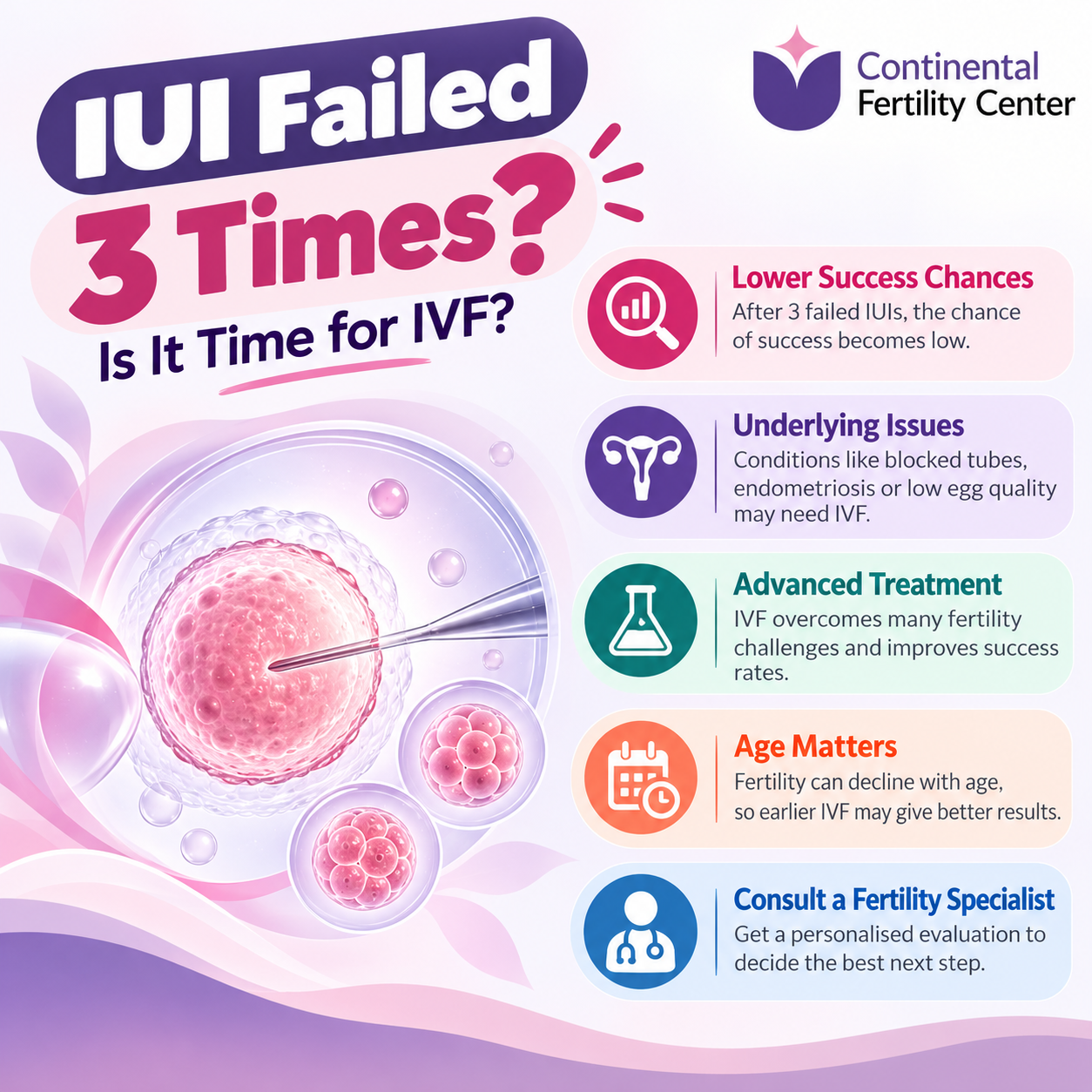
- Pregnancy has not occurred after three or more well-timed IUI attempts.
- You have reduced ovarian reserve or advanced reproductive age.
- There are significant sperm-related fertility concerns.
- You have blocked fallopian tubes.
- Previous investigations indicate conditions that may reduce IUI success.
Moving to IVF does not mean giving up. It means choosing a treatment that may better address the underlying fertility challenges.
IUI vs IVF: What Is the Difference?
Both treatments help couples achieve pregnancy, but they work differently.
| IUI Treatment | IVF Treatment |
| Sperm is placed inside the uterus. | Egg and sperm are combined in a laboratory. |
| Fertilisation happens inside the body. | Fertilisation happens outside the body. |
| Requires at least one suitable, functional fallopian tube. | Does not require open fallopian tubes. |
| Generally less invasive. | Involves ovarian stimulation and egg retrieval. |
| Usually considered an initial treatment option. | May be recommended after IUI failure or for specific fertility conditions. |
IVF after a failed IUI may offer a more suitable approach depending on the couple's fertility diagnosis and medical history.
What Happens After Repeated IUI Failure?
After repeated IUI failure, your fertility specialist may recommend a fresh evaluation before starting IVF.
This may include:
1. Hormonal testing to assess reproductive health.
2. Ovarian reserve assessment.
3. Ultrasound examination of the uterus and ovaries.
4. Semen analysis to evaluate sperm health.
5. Assessment of fallopian tube function.
6. Review of previous IUI cycles and treatment response.
These investigations help create an individualized IVF treatment plan.
Why Choose Continental Fertility Center?
Choosing the right fertility center is an important step when transitioning from IUI to IVF. Continental Fertility Center, Hyderabad, provides comprehensive fertility evaluation and personalized reproductive care.
Continental Hospitals is accredited by JCI and NABH, reflecting its commitment to international healthcare standards, patient safety, and quality clinical practices. Its multidisciplinary medical facilities support coordinated care throughout the fertility journey.
Key benefits include:
- Experienced fertility and reproductive medicine specialists.
- Advanced fertility investigations and diagnostic facilities.
- Personalized IUI and IVF treatment planning.
- Modern reproductive medicine and laboratory support.
- Individualized treatment based on fertility history.
- Patient counseling and continuous medical guidance.
Conclusion
Experiencing failed IUI treatment three times can be disappointing, but it does not mean you cannot become parents. Repeated unsuccessful cycles may indicate that it is time to explore IVF or reassess your fertility treatment strategy.
The decision to move from IUI to IVF depends on your age, ovarian reserve, sperm health, and underlying fertility concerns. Early evaluation and the right treatment approach can help avoid unnecessary delays.
If you have experienced repeated IUI failures or are unsure about your next fertility treatment, consult our best fertility specialist in Hyderabad at Continental Fertility Center, Hyderabad. Get a personalized fertility assessment and understand whether IVF is the right next step towards achieving your dream of parenthood.
Frequently Asked Questions
Experiencing three unsuccessful IUI cycles can be emotionally challenging. However, it does not mean that pregnancy is impossible. Your fertility specialist may recommend reviewing your treatment plan. The next step depends on your age, ovarian reserve and fertility diagnosis. Your partner's sperm quality is also an important factor. The condition of your fallopian tubes and uterus may need reassessment. Your doctor may recommend additional fertility investigations. If repeated IUI cycles have not resulted in pregnancy, IVF may be considered. IVF allows fertilisation to take place in a laboratory. It may be more suitable for certain fertility conditions. However, moving to IVF is not necessary for everyone after three failed cycles. Your specialist will discuss the potential benefits and limitations. A personalised fertility evaluation can help determine the next step.
The decision to move from IUI to IVF depends on several fertility factors. Your doctor may consider IVF after multiple unsuccessful IUI cycles. Age is an important factor when planning fertility treatment. Women with reduced ovarian reserve may need a different treatment approach. Blocked fallopian tubes can also make IVF more appropriate. Severe male factor infertility may require IVF with additional techniques. The duration of infertility is another important consideration. Previous fertility treatment outcomes can help guide decisions. Your doctor may recommend reviewing hormone levels and ultrasound findings. IVF may offer a more suitable option in certain situations. However, it is not automatically required after three failed IUI attempts. Discuss your chances of success with your fertility specialist. An individual treatment plan can help avoid unnecessary delays.
Yes, pregnancy may still be possible after unsuccessful IUI treatment. An unsuccessful IUI cycle does not mean that you cannot conceive. Fertility depends on several factors, including age and reproductive health. Some couples may benefit from trying another treatment cycle. Others may achieve better outcomes with IVF. Your ovarian reserve and egg quality can influence fertility treatment decisions. Sperm quality and uterine health are also important. Your specialist may review previous IUI reports and test results. Additional investigations may help identify possible reasons for unsuccessful cycles. Lifestyle factors and certain medical conditions may also affect fertility. Avoid comparing your treatment journey with other couples. Every person's reproductive health is different. Discuss the available options with your fertility specialist. The right treatment approach depends on your individual circumstances.
The recommended number of IUI cycles varies from couple to couple. Many fertility specialists consider three to four cycles in suitable patients. However, the number depends on age and the cause of infertility. Younger women with unexplained infertility may be advised to try multiple cycles. Women with reduced ovarian reserve may need earlier treatment decisions. Severe sperm-related fertility problems may also require a different approach. The condition of the fallopian tubes is important for IUI. At least one open fallopian tube is generally needed for the procedure. Your previous treatment response can help guide the next step. Repeated unsuccessful cycles may lead your doctor to discuss IVF. There is no fixed number that applies to every patient. Your specialist will evaluate your medical history and test results. Discuss the expected benefits of continuing IUI before starting another cycle.
IVF and IUI are different fertility treatments designed for different situations. IUI involves placing prepared sperm directly into the uterus around ovulation. Fertilisation still takes place naturally inside the body. IVF involves collecting eggs and fertilising them with sperm in a laboratory. The resulting embryos are then transferred into the uterus. IVF generally offers higher success rates per treatment cycle for many patient groups. However, outcomes depend on age, diagnosis and embryo quality. IUI is usually less invasive and involves fewer treatment steps. IVF may be more suitable for blocked fallopian tubes or certain severe fertility problems. It may also be considered after repeated unsuccessful IUI cycles. Neither treatment guarantees pregnancy. Your fertility specialist can compare the expected outcomes of both options. The most appropriate treatment depends on your reproductive health and individual needs.
IUI treatment may be unsuccessful for several medical reasons. Poor egg quality can affect fertilisation and early embryo development. Low sperm count or reduced sperm motility may lower the chances of conception. Problems with ovulation can also affect treatment outcomes. Blocked fallopian tubes prevent the egg and sperm from meeting naturally. Age-related changes in fertility may influence pregnancy chances. Endometriosis and certain uterine conditions can also contribute to infertility. Sometimes fertilisation does not occur despite appropriate timing. In other cases, an embryo may not develop or implant successfully. Some unsuccessful cycles occur without an identifiable reason. Your doctor may review hormone tests and ultrasound reports. A reassessment can help identify factors affecting conception. Understanding the possible cause can guide your next fertility treatment decision.
IVF involves several steps, but most procedures are performed with appropriate pain management. Hormonal injections are used to stimulate the ovaries to produce multiple eggs. Some women experience mild discomfort, bloating or abdominal fullness during stimulation. Egg retrieval is usually performed under sedation or anaesthesia. This helps minimise discomfort during the procedure. Mild cramping or spotting may occur after egg retrieval. Embryo transfer is generally a simple procedure and usually does not require anaesthesia. Some women experience mild discomfort during the transfer. The overall experience varies from person to person. Your fertility specialist will explain each stage before treatment begins. Following medical instructions can help make the process more comfortable. Report severe pain, heavy bleeding or other unusual symptoms to your doctor. Your care team will guide you throughout the IVF journey.
Several investigations may be recommended before starting IVF treatment. Your doctor may evaluate ovarian reserve through AMH testing. Follicle-stimulating hormone levels may also be assessed. An ultrasound helps examine the ovaries and uterus. Your specialist may recommend checking the uterine cavity when necessary. Thyroid function and other hormone tests may be advised based on your medical history. Blood tests can help assess general health and identify nutritional concerns. Your partner may need a semen analysis to evaluate sperm quality. Additional investigations may be recommended if previous IUI cycles were unsuccessful. Screening tests may also be required before treatment. Not every patient needs the same set of investigations. Your doctor will select tests according to your fertility history. These results help develop a personalised IVF treatment plan.