
Is IVF Pregnancy Different From Natural Pregnancy?
For couples experiencing challenges with fertility, assisted reproductive technology provides a reliable path toward parenthood. In vitro fertilization, commonly known as IVF, has helped millions of families welcome healthy babies into the world. However, many individuals embarking on this journey often wonder about the realities of the gestation period itself. Is an IVF pregnancy fundamentally different from a natural pregnancy?
Understanding the similarities and differences between these two paths to parenthood can ease anxiety and help couples prepare for the journey ahead. While the method of conception is entirely distinct, the biological journey of carrying a child shares almost identical milestones. For those seeking clarity, looking at how the two processes compare across key stages reveals what to expect during the transition from a clinical procedure to a typical pregnancy journey.
What Is the Main Difference in How Conception Occurs?
The primary distinction between an IVF pregnancy and a natural pregnancy lies entirely in the location and method of fertilization. In a natural pregnancy, conception happens internally within the female reproductive tract. After ovulation, a mature egg travels down the fallopian tube, where it meets and is fertilized by a sperm cell. The resulting embryo then travels to the uterus and implants into the uterine lining naturally.
During an IVF treatment, the fertilization process takes place in a highly controlled laboratory environment. The key steps of this clinical phase include:
- Ovarian Stimulation: The woman takes specialized medications to encourage her ovaries to produce multiple mature eggs.
- Egg Retrieval: A reproductive specialist performs a minor, ultrasound-guided procedure to collect the mature eggs from the ovaries.
- Laboratory Fertilization: The collected eggs are combined with a sperm sample in a specialized embryology lab to facilitate fertilization.
- Embryo Transfer: The resulting healthy embryo is carefully transferred directly into the woman's uterus using a thin catheter.
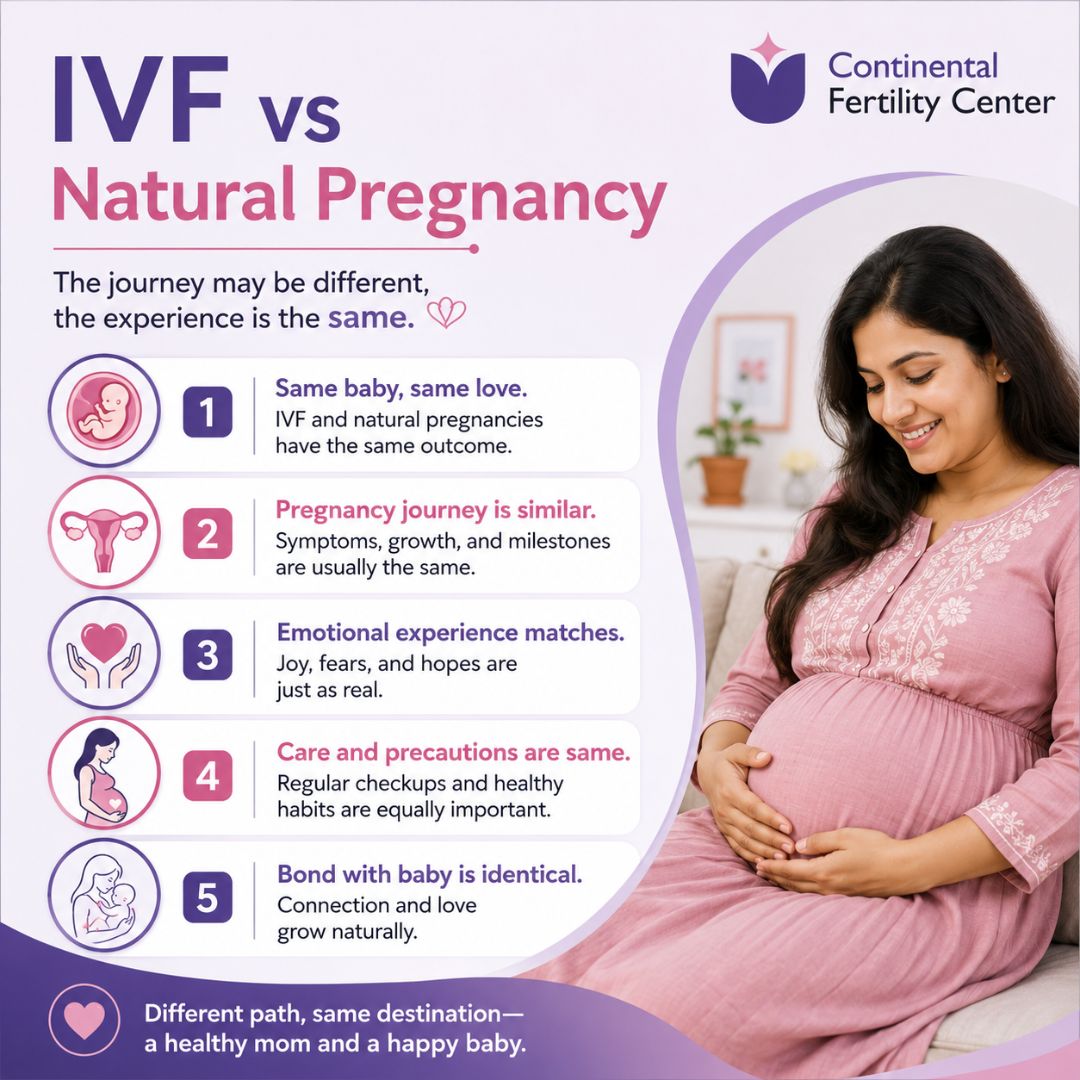
Once the embryo successfully implants into the uterine wall during an IVF cycle, the biological process of growing a baby aligns closely with the progression of a traditional natural pregnancy.
Are the Early Symptoms and Signs the Same?
Do women experience the same early signs when conceiving through medical assistance compared to a natural pregnancy? Yes, the classic signs of early pregnancy remain largely identical because they are driven by the same rising pregnancy hormones.
Once implantation occurs, both paths trigger the production of human chorionic gonadotropin, or hCG. This hormone is responsible for the typical early signs that women notice in the initial weeks. Common shared experiences include:
- A missed menstrual cycle
- Nausea and morning sickness
- Fatigue and elevated tiredness
- Breast tenderness and sensitivity
- Frequent urination
The only notable difference in the early weeks is that women undergoing IVF are often more hyper-aware of minor bodily changes. Because the exact day of embryo transfer is known, the typical two-week waiting period before a pregnancy test involves close monitoring, making normal hormonal shifts more noticeable than they might be in an unassisted natural pregnancy.
Does an IVF pregnancy require extra medical care?
Is the prenatal care schedule identical for both conception methods? While a natural pregnancy is usually monitored by an obstetrician starting around the eighth week, an IVF pregnancy involves extra medical supervision during the very early stages.
Because the conception occurs outside the body, the natural hormonal signals that support early implantation need temporary medical reinforcement. The initial management differences include:
Hormonal Support: Women who conceive via IVF typically receive progesterone supplements, either through injections or vaginal gels, for the first eight to twelve weeks to ensure the uterine lining remains thick and stable.
Frequent Early Scans: Blood tests and early ultrasounds are performed much sooner and more frequently in a fertility clinic setup to verify stable hormone growth and early cardiac activity.
Transition to Routine Care: Once the pregnancy reaches the ten to twelve-week milestone and proves stable, the patient graduates from the fertility center and transitions to routine prenatal care, matching the standard check-up schedule of a natural pregnancy.
Are the Health Risks Different for the Baby and Mother?
Are there greater risks associated with a baby conceived through fertility treatment compared to a natural pregnancy? The vast majority of IVF pregnancies progress smoothly, resulting in perfectly healthy babies. However, certain statistical differences exist, primarily due to maternal age or the underlying reasons why the couple faced infertility initially.
Medical data shows a few areas where the risk profiles vary slightly:
Multiple Births: IVF carries a slightly higher probability of twins or triplets if more than one embryo is transferred, whereas a natural pregnancy resulting in multiples depends purely on natural cell division or multiple ovulations.
Preterm Delivery: There is a slightly higher statistical chance of early delivery or lower birth weight in assisted pregnancies, which is often linked to the underlying fertility factors of the parents rather than the laboratory procedure itself.
Delivery Methods: Women who conceive via IVF have a slightly higher rate of cesarean sections, which is frequently attributed to increased medical caution around precious pregnancies or advanced maternal age.
Why Choose Continental Fertility Center for Reproductive Care?
When facing infertility or planning an assisted reproductive journey, selecting an advanced medical institution is vital for a safe and successful outcome. Continental Hospitals is recognized as the best hospital in Hyderabad, offering comprehensive, world-class fertility treatments and comprehensive obstetric care under one roof.
Continental Hospitals stands out due to its unwavering commitment to patient safety and clinical excellence, backed by prestigious national and international accreditations. The institution holds the National Accreditation Board for Hospitals & Healthcare Providers, or NABH, accreditation, which guarantees adherence to strict medical protocols, clean environments, and high-quality patient care standards.
The Continental Fertility Centre features an advanced embryology laboratory, cutting-edge diagnostic infrastructure, and highly sophisticated genetic testing facilities. By choosing this multi-specialty institution, couples benefit from an integrated approach where reproductive endocrinologists, embryologists, and high-risk pregnancy experts work together, ensuring a seamless transition from a successful IVF conception to a healthy delivery.
Conclusion
While the initial stages of conception and early medical monitoring differ, an IVF pregnancy eventually mirrors a natural pregnancy in almost every biological way. The milestones, the development of the baby, the physical changes in the mother, and the ultimate joy of childbirth remain beautifully identical. The laboratory assistance simply bridges the gap where nature faced a roadblock, allowing the normal process of gestation to take its course.
If you suffer from infertility or have questions about how assisted reproductive techniques can help you start a family, seeking professional guidance from an experienced specialist can give you the clarity and support you need.
Book a consultation with our best fertility specialist in Hyderabad at Continental Hospitals today to explore your options and plan your path to a healthy pregnancy.
Related Blog Topics:
Frequently Asked Questions
An IVF pregnancy begins differently because fertilization takes place in a laboratory before the embryo is transferred into the uterus. Once the embryo successfully implants, the pregnancy develops in the same way as a naturally conceived pregnancy. The baby's growth, organ development, and milestones are identical. IVF pregnancies may involve closer monitoring during the early weeks because many couples have experienced infertility or previous pregnancy losses. Doctors may recommend additional blood tests and ultrasound scans to confirm healthy progress. Most women with IVF pregnancies go on to have normal pregnancies and deliver healthy babies. The overall experience after implantation is very similar to natural pregnancy. Following medical advice, eating a balanced diet, attending regular prenatal visits, and maintaining a healthy lifestyle are the most important factors for a successful pregnancy, regardless of how conception occurred.
Not every IVF pregnancy is considered high risk. The level of risk depends on factors such as the mother's age, overall health, underlying medical conditions, and whether she is carrying a single baby or twins. Women undergoing IVF are often older or may have health conditions that contributed to infertility, which can increase pregnancy risks. However, many IVF pregnancies progress without complications. Doctors usually provide more frequent prenatal monitoring during the first trimester to ensure the pregnancy is developing normally. Regular checkups help detect and manage any concerns early. With proper prenatal care and healthy lifestyle choices, many women experience smooth pregnancies and deliver healthy babies.
Yes, IVF pregnancies often involve additional monitoring during the early stages. Doctors usually perform blood tests to measure hormone levels and schedule ultrasound scans to confirm embryo implantation and fetal heartbeat. These extra visits provide reassurance and help identify any concerns as early as possible. After the first trimester, if the pregnancy is progressing normally, prenatal care often becomes similar to that of a naturally conceived pregnancy. Routine screenings, growth scans, and antenatal appointments continue according to standard pregnancy guidelines. The goal is to support both the mother's health and the baby's development throughout the pregnancy.
Yes, IVF babies are generally as healthy as babies conceived naturally. Extensive research has shown that most children born through IVF grow, develop, and achieve milestones just like other children. Their physical, emotional, and intellectual development is comparable to naturally conceived children. The health of the baby depends more on genetic factors, maternal health, prenatal care, and lifestyle than on the method of conception. Regular prenatal monitoring and timely medical care help support healthy pregnancy outcomes. Millions of healthy babies have been born through IVF worldwide, giving hope to families facing infertility.
An IVF pregnancy does not automatically require a cesarean section. Many women with IVF pregnancies have normal vaginal deliveries when there are no medical complications. The mode of delivery depends on factors such as the baby's position, maternal health, pregnancy complications, and obstetric recommendations. In some cases, a cesarean delivery may be advised due to advanced maternal age, multiple pregnancies, or other medical conditions rather than IVF itself. Your obstetrician will monitor the pregnancy closely and recommend the safest delivery method based on your individual circumstances.
Most pregnancy symptoms after IVF are the same as those experienced in natural pregnancy. Women may experience nausea, breast tenderness, fatigue, mood changes, food cravings, and frequent urination. During the early weeks, some symptoms may also be influenced by fertility medications such as progesterone supplements, making it difficult to distinguish medication effects from pregnancy symptoms. Every pregnancy is unique, and symptom intensity varies from person to person. The presence or absence of symptoms does not always indicate whether the pregnancy is progressing normally. Regular medical checkups remain the most reliable way to monitor pregnancy health.
In most cases, women with uncomplicated IVF pregnancies can safely exercise and travel after receiving approval from their doctor. Gentle activities such as walking, prenatal yoga, and stretching can support overall health during pregnancy. High impact sports and strenuous physical activities should be avoided unless specifically recommended by a healthcare provider. Travel is usually considered safe during the second trimester if there are no pregnancy complications. It is important to stay hydrated, take regular breaks during long journeys, and attend scheduled prenatal appointments. Always discuss travel plans and exercise routines with your obstetrician.
Supporting a healthy IVF pregnancy involves following your fertility specialist's and obstetrician's advice throughout pregnancy. Take prescribed medications exactly as instructed, including progesterone or other supplements if recommended. Eat a balanced diet rich in fruits, vegetables, protein, whole grains, and essential nutrients. Stay physically active with doctor approved exercises, get adequate sleep, and manage stress through relaxation techniques. Avoid smoking, alcohol, and recreational drugs. Attend every prenatal appointment for timely monitoring and screening. Report any unusual symptoms such as bleeding, severe pain, or reduced fetal movements promptly. Good prenatal care and healthy lifestyle choices significantly improve the chances of a successful pregnancy and healthy baby.