
Luteal Phase Support During IVF: Types of Progesterone and When It’s Used
Luteal phase support in IVF is an important part of fertility treatment that helps prepare the uterus to support an embryo after egg retrieval and embryo transfer. During a natural menstrual cycle, the hormone progesterone is produced after ovulation. It helps the uterine lining become suitable for implantation and supports the early stages of pregnancy.
During IVF, the natural hormonal process can be different because medicines used for ovarian stimulation and egg retrieval may affect the body's own progesterone production. This is why fertility specialists may recommend progesterone support after IVF. The treatment is carefully planned according to the IVF cycle, embryo transfer timing, and individual medical needs.
Why is progesterone used during IVF?
Progesterone is a key hormone for preparing and maintaining the uterine lining. After an embryo is transferred, the uterus needs the right hormonal environment for implantation and early pregnancy development.
Progesterone in IVF may help the following:
- Support the development of the uterine lining
- Maintain the lining after embryo transfer
- Create a suitable environment for embryo implantation
- Support the early stages of pregnancy
- Compensate for reduced natural progesterone production in some IVF cycles
Luteal phase support during IVF is therefore commonly included as part of the treatment plan. However, the type, dose, route, and duration of progesterone can vary from one patient to another.
What are the different types of progesterone used in IVF?
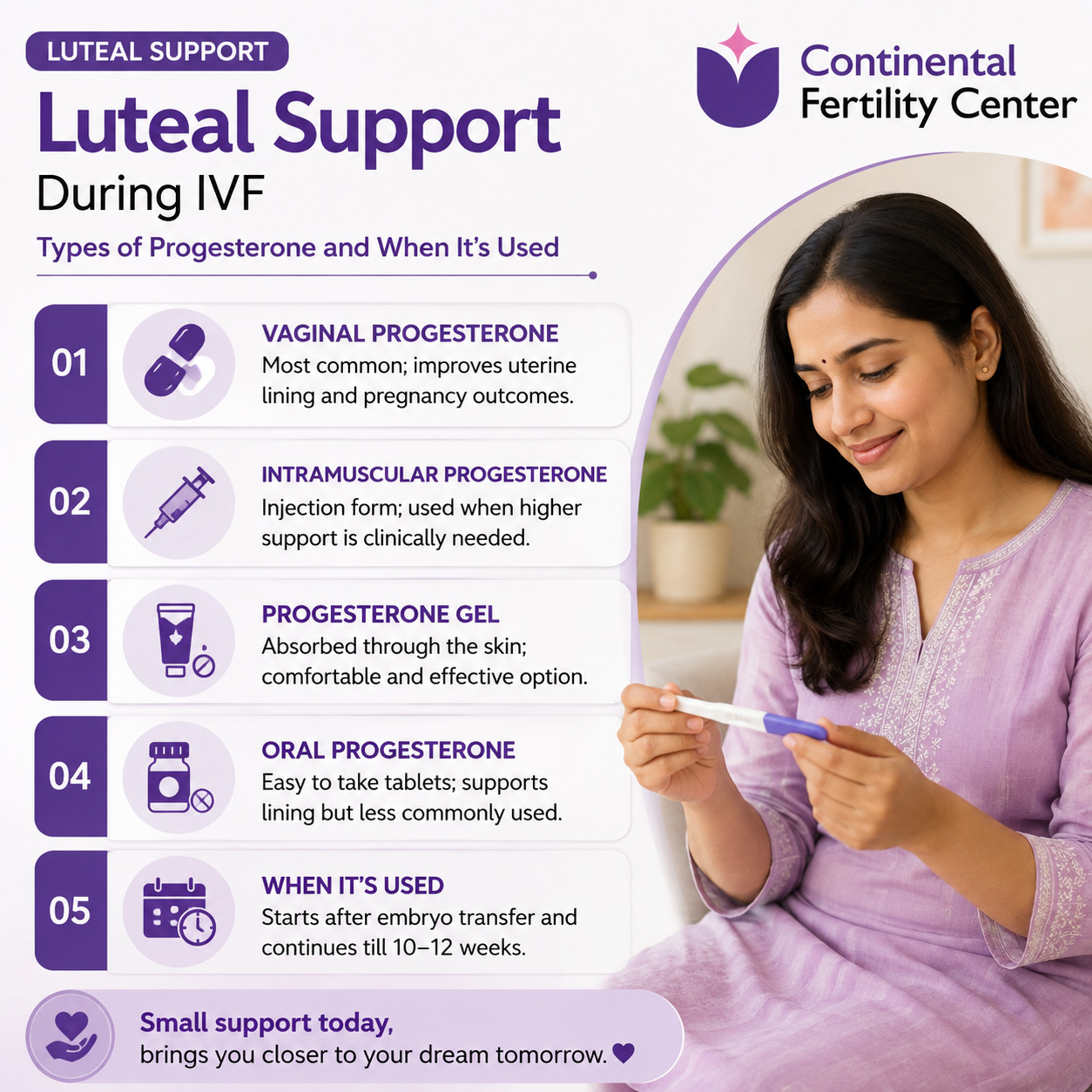
Progesterone can be given in different forms depending on the fertility specialist's recommendation. The commonly used options include vaginal progesterone, oral progesterone in selected situations, and injectable progesterone.
What is vaginal progesterone?
Vaginal progesterone is commonly used for IVF luteal support. It is available as capsules, tablets, gels, or other formulations depending on the treatment plan.
The medicine is placed in the vagina, allowing progesterone to act directly around the uterus. Your fertility specialist will explain the correct method of use and timing.
When are progesterone injections used?
Injectable progesterone may be recommended when the fertility specialist believes additional or alternative hormonal support is appropriate. It delivers progesterone through the bloodstream and may be used in selected IVF treatment plans.
The decision depends on factors such as the IVF protocol, previous treatment history, hormone levels, and the doctor's clinical assessment.
Is oral progesterone used for IVF?
Oral progesterone may be considered in some fertility treatment protocols, but it is not automatically suitable for every patient. The way progesterone is absorbed and processed can differ depending on the form of medicine.
Patients should not change the type or route of progesterone without discussing it with their fertility specialist.
When is progesterone started during IVF?
When progesterone is started depends on the type of IVF cycle and the timing of embryo transfer. In many treatment protocols, progesterone is started around the time of ovulation or egg retrieval and continued through embryo transfer and the early pregnancy period when advised by the fertility specialist.
The exact timing is important because the uterine lining and embryo development need to remain synchronized. This is one reason why patients should follow their prescribed IVF medication schedule carefully.
How long is progesterone support continued after embryo transfer?
How long progesterone after embryo transfer is continued can vary between patients and treatment protocols. If pregnancy occurs, the fertility specialist may recommend continuing progesterone for a period during early pregnancy.
The decision may depend on the type of IVF cycle, pregnancy test results, hormonal support required, and the patient's individual clinical situation.
Patients should not stop progesterone on their own, even if they experience spotting or have concerns after embryo transfer. Any change in medication should be discussed with the treating fertility specialist.
What happens if progesterone levels are low after IVF?
Low progesterone levels may require closer evaluation during an IVF cycle. Depending on the clinical situation, the fertility specialist may review the timing and type of progesterone support and may recommend blood tests or other assessments.
It is important to remember that progesterone levels can vary depending on the medication route and the timing of testing. A single test result does not always provide the complete picture. Your fertility specialist will interpret hormone levels together with the IVF treatment plan and other clinical findings.
Can progesterone guarantee IVF success?
Can progesterone for IVF success guarantee pregnancy? No. Progesterone is an important part of luteal phase support in IVF, but it cannot guarantee implantation or pregnancy.
IVF success can depend on several factors, including embryo quality, age, reproductive health, uterine factors, sperm quality, ovarian response, and the overall treatment plan.
The purpose of progesterone support is to provide an appropriate hormonal environment for implantation and early pregnancy. Your fertility specialist can explain how progesterone fits into your individual treatment plan.
What should you remember while taking progesterone after IVF?
Patients receiving progesterone support after IVF should follow their prescribed schedule carefully. Helpful points include:
- Take or use progesterone exactly as prescribed.
- Do not change the dose without medical advice.
- Do not stop progesterone suddenly unless your doctor tells you to.
- Follow the recommended timing around embryo transfer.
- Inform your fertility team about unusual bleeding, severe pain, or other concerning symptoms.
- Attend scheduled follow-up appointments and pregnancy testing.
- Ask your doctor if you are unsure about the correct method of using progesterone.
Why choose Continental Fertility Center for IVF care?
Choosing the right fertility team is an important part of the IVF journey. At Continental Fertility Center, fertility care is designed around individual patient needs, with attention to diagnosis, treatment planning, embryo transfer, hormonal support, and follow-up care.
Continental Hospitals in Hyderabad is a JCI- and NABH-accredited healthcare facility offering multispecialty, tertiary, and quaternary care. The hospital also has advanced infrastructure and multidisciplinary clinical services that can support patients who require coordinated medical care.
For patients looking for a fertility center associated with a trusted healthcare environment, Continental Fertility Center combines fertility expertise with the wider clinical support available within Continental Hospitals. This can be especially valuable when a patient's fertility journey requires evaluation or care from other medical specialties.
When should you speak to a fertility specialist about luteal phase support?
If you are undergoing IVF or planning embryo transfer, your fertility specialist can explain whether luteal phase support in IVF is recommended for your treatment and which progesterone option is appropriate.
If you have questions about progesterone after embryo transfer, medication timing, spotting, hormone levels, or previous IVF treatment outcomes, discuss them with your fertility team rather than changing medication yourself.
If you are struggling with infertility or need personalized guidance for IVF treatment, consult a fertility specialist at Continental Fertility Center for an individualized evaluation and treatment plan.
Conclusion
Luteal phase support in IVF plays an important role in creating and maintaining a suitable uterine environment after ovulation, egg retrieval, and embryo transfer. Progesterone may be provided through vaginal, injectable, or selected oral forms depending on the IVF protocol and individual requirements.
Understanding why progesterone is prescribed and when it is used can help patients follow their IVF treatment plan with greater confidence. However, every fertility journey is different, and progesterone support should always be personalized by a qualified fertility specialist.
If you are suffering from infertility or facing challenges with conception, seeking timely guidance from the best fertility specialist in Hyderabad can help you understand your options and take the next step toward personalized fertility care.
Frequently Asked Questions
Progesterone helps prepare the uterine lining for embryo implantation. During IVF, the body's natural progesterone production may not be enough to support the luteal phase. Fertility medicines used during treatment can affect normal hormone production. Progesterone supplementation helps maintain the endometrium in a suitable state for implantation. It also supports the early stages of pregnancy after embryo transfer. Doctors commonly recommend progesterone after egg retrieval or embryo transfer, depending on the IVF protocol. The exact timing varies based on the treatment cycle and embryo transfer plan. Progesterone may be given through the vagina, by injection, or sometimes orally. Vaginal progesterone is commonly used because it delivers the hormone close to the uterus. Some patients may need a combination of progesterone methods. The dose is selected according to individual treatment needs. Progesterone support is usually continued until the pregnancy test and, if positive, for a period advised by the fertility specialist.
The timing of progesterone depends on the type of IVF cycle being used. In a fresh embryo transfer cycle, progesterone is often started after egg retrieval. It may be started on the day of egg retrieval or shortly afterward, depending on the clinic's protocol. In a frozen embryo transfer cycle, the timing depends on whether the cycle is natural, modified natural, or hormone replacement based. For a hormone replacement cycle, progesterone is usually started after the uterine lining has been prepared with estrogen. The embryo transfer is then scheduled according to the number of days of progesterone exposure. This helps synchronize the uterine lining with the developmental stage of the embryo. Starting progesterone at the correct time is important for implantation. Patients should follow the exact schedule provided by their fertility specialist. Missing doses can affect the planned hormone support. Do not change the dose or timing without medical advice. Your doctor will determine the appropriate progesterone schedule based on your IVF protocol.
Several forms of progesterone can be used for luteal phase support during IVF. Vaginal progesterone is one of the most commonly used options. It may be available as vaginal capsules, tablets, or gels. Injectable progesterone is another option and is usually given as an intramuscular injection. Some treatment plans may use oral progesterone, although its use depends on the specific medicine and clinical protocol. Vaginal progesterone is often preferred because it provides strong local exposure to the uterus. Injectable progesterone can be useful when vaginal treatment is not suitable or when additional support is considered appropriate. Some fertility specialists use a combination of vaginal and injectable progesterone. The choice depends on factors such as the IVF protocol, previous treatment response, and individual needs. There is no single progesterone method that is ideal for every patient. Your fertility specialist will choose the most suitable form and dose. Patients should use progesterone exactly as prescribed throughout the recommended support period.
Vaginal progesterone is widely used for luteal phase support during IVF. It delivers progesterone directly through the vaginal route and provides exposure to the uterus. Different formulations, including capsules, tablets, and gels, may be prescribed. Research supports the use of vaginal progesterone as an effective option for many patients undergoing IVF. The exact medicine and dose depend on the fertility clinic's protocol. Some patients may experience mild vaginal discharge or irritation while using it. These effects are usually related to the route of administration. Vaginal progesterone can also be convenient because it does not require injections. However, it needs to be used consistently and at the prescribed times. Effectiveness can depend on the overall IVF treatment plan rather than progesterone alone. Some patients may require additional hormonal support based on their clinical situation. Your doctor will decide whether vaginal progesterone is appropriate for you. Do not stop progesterone after embryo transfer unless your fertility specialist advises you to do so.
Progesterone injections are not required for every IVF patient. They are one of several options available for luteal phase support. Injectable progesterone is usually given as an intramuscular injection. Some fertility specialists use injections alone, while others may combine them with vaginal progesterone. The choice depends on the IVF protocol and the patient's individual circumstances. Injectable progesterone can provide reliable systemic hormone levels. However, injections may cause soreness, bruising, or discomfort at the injection site. For some patients, vaginal progesterone may be more convenient. There is no universal requirement for progesterone injections after every embryo transfer. Your fertility specialist will assess which route is most appropriate for your treatment. The decision may also depend on previous IVF outcomes and how your body responds to progesterone support. If injections are prescribed, follow the schedule carefully. Never replace injections with another form of progesterone without consulting your doctor.
Progesterone is generally continued after embryo transfer according to the IVF clinic's treatment protocol. It is commonly continued until the pregnancy test is performed. If the pregnancy test is positive, progesterone support may be continued into early pregnancy. The exact duration varies between patients and treatment protocols. Some fertility specialists continue progesterone until around the first trimester, while others may use a different stopping point. The body eventually produces progesterone through the developing pregnancy and placenta. Until that transition is established, hormonal support may be recommended. Patients should not stop progesterone simply because they feel well or because early pregnancy symptoms are absent. Stopping treatment too early without medical advice may be inappropriate. Your fertility specialist will tell you when it is safe to reduce or stop the medication. The duration may also differ between fresh and frozen embryo transfer cycles. Always follow the individual instructions provided by your fertility team.
Missing a progesterone dose during IVF can cause concern, but one missed dose does not automatically mean that the treatment has failed. The appropriate action depends on the type of progesterone and how long ago the dose was missed. Patients should follow the instructions provided by their fertility clinic. In many cases, the clinic may advise taking the missed dose when remembered unless it is almost time for the next dose. Patients should not automatically take an extra dose unless their doctor recommends it. If you miss an injection, contact your fertility team for specific instructions. Consistent progesterone use is important because the hormone supports the uterine lining during the implantation period. Repeated missed doses should be discussed promptly with your fertility specialist. Do not stop progesterone because of mild side effects without medical advice. Keeping a medication schedule or setting reminders can help prevent missed doses. If you are unsure what to do after missing a dose, contact your IVF clinic rather than changing the schedule yourself.
Progesterone is an important part of luteal phase support in many IVF treatment protocols. It helps prepare and maintain the uterine lining for embryo implantation and early pregnancy. Adequate progesterone support is particularly important because IVF medicines can affect normal luteal phase hormone production. However, progesterone alone does not guarantee successful implantation or pregnancy. IVF success depends on several factors, including embryo quality, maternal age, uterine health, and the underlying cause of infertility. The type, dose, and timing of progesterone may also vary between patients. Fertility specialists use evidence-based protocols to provide appropriate hormonal support. Additional progesterone does not necessarily mean a higher chance of success for every patient. Taking more progesterone than prescribed is not recommended. Your doctor may adjust the treatment based on your individual response and clinical findings. Continue progesterone exactly as instructed after embryo transfer. If you have questions about your medication, discuss them with your fertility specialist.