
PGT-A vs PGT-M: Understanding Genetic Testing Before IVF
Planning for a baby through IVF brings hope, excitement, and many important decisions. One topic that often raises questions is PGT A vs PGT M. These advanced genetic testing methods help fertility specialists gather valuable information about embryos before implantation. Understanding the difference between these tests can help couples make informed choices and improve their IVF journey.
Many people searching for PGT A vs PGT M wonder which test is right for them and whether they need genetic testing before IVF. The answer depends on several factors, including family history, previous pregnancies, age, and specific genetic conditions. At Continental Fertility Center, our fertility specialists provide personalized guidance to help every couple choose the most appropriate treatment based on their medical needs.
What is PGT-A vs. PGT-M?
PGT-A vs. PGT-M refers to two different types of preimplantation genetic testing performed during IVF.
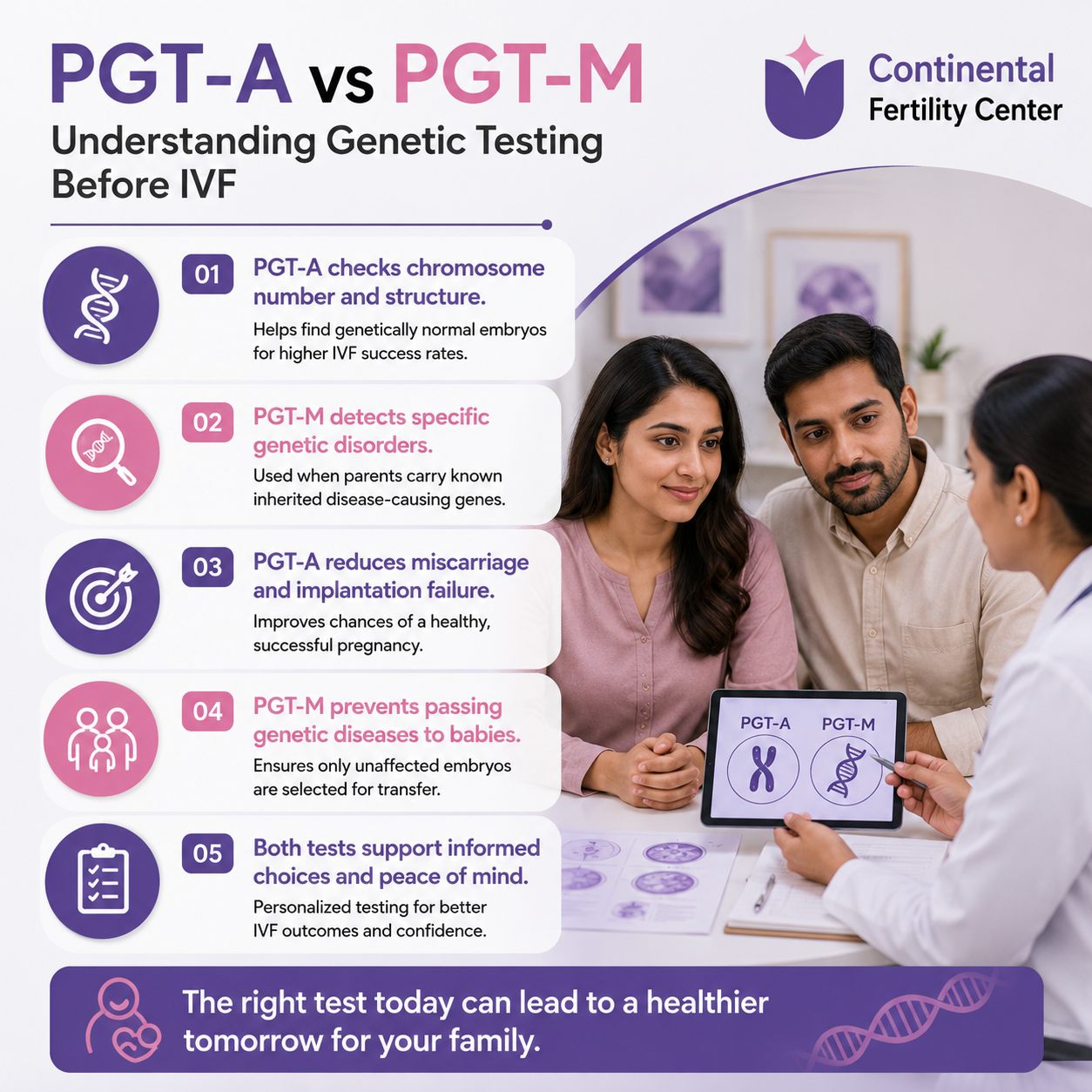
PGT-A stands for Preimplantation Genetic Testing for Aneuploidy. This test checks whether an embryo has the correct number of chromosomes. Healthy chromosome numbers are important for successful implantation, pregnancy, and fetal development.
PGT M stands for Preimplantation Genetic Testing for Monogenic Disorders. This test looks for specific inherited genetic diseases that may be passed from parents to their child.
Although both tests are performed before embryo transfer, they serve different purposes. Understanding PGT-A vs. PGT-M helps couples receive the right testing based on their individual circumstances.
Why is Genetic Testing Before IVF Important?
Genetic testing before IVF provides valuable information about embryo health before pregnancy begins. It helps fertility specialists identify embryos that are most suitable for transfer while reducing the chance of passing certain inherited conditions to the baby.
Some important benefits include:
- Better embryo selection
- Improved implantation chances
- Lower risk of certain genetic disorders
- Reduced chances of miscarriage in selected cases
- More informed treatment decisions
- Personalized fertility care
Not every IVF patient requires genetic testing. Your fertility specialist will recommend the appropriate test based on your medical history and family background.
What is PGT A?
PGT A evaluates the chromosome number within an embryo.
Every healthy embryo should have the correct number of chromosomes. If an embryo has extra or missing chromosomes, it may not implant successfully or could result in pregnancy loss or certain chromosomal conditions.
PGT-A is commonly recommended for:
- Women with advanced maternal age
- Couples with repeated IVF failures
- Patients with recurrent miscarriages
- Couples seeking better embryo selection
- Patients with multiple embryos available for transfer
PGT A does not diagnose inherited genetic diseases. Instead, it focuses on chromosome health.
What is PGT M?
PGT M is designed to identify specific inherited genetic disorders.
If one or both partners carry a known genetic mutation, there is a possibility of passing that condition to their child. PGT M helps identify embryos that do not carry the disease before embryo transfer.
PGT-M may be recommended for couples with:
- A family history of inherited diseases
- Previous child affected by a genetic disorder
- Known carrier status for genetic conditions
- Certain inherited blood disorders
- Neurological or metabolic genetic disorders
This type of IVF genetic testing helps reduce the risk of transmitting specific hereditary conditions.
PGT-A vs. PGT-M: What is the Difference?
The main difference between PGT-A and PGT-M lies in what each test examines.
| PGT A | PGT M |
|---|---|
| Checks chromosome number | Detects specific inherited gene disorders |
| Identifies chromosomal abnormalities | Identifies known genetic mutations |
| Helps improve embryo selection | Helps prevent passing inherited diseases |
| Often recommended based on maternal age or IVF history | Recommended when a genetic condition runs in the family |
Your fertility specialist may recommend one test or, in some situations, both tests depending on your medical needs.
Who Should Consider Genetic Screening in IVF?
Genetic screening in IVF may be beneficial if you have:
- Recurrent pregnancy loss
- Multiple unsuccessful IVF cycles
- Advanced maternal age
- Known genetic disorders in the family
- Carrier status for inherited diseases
- Previous child with a genetic condition
- History of chromosomal abnormalities
- Need for personalized embryo selection
A detailed consultation with a fertility expert helps determine whether genetic testing before IVF is appropriate.
How is IVF genetic testing performed?
During the IVF process, embryos are carefully developed in the laboratory.
A few cells are gently collected from each embryo without affecting its ability to continue developing. These samples are then analyzed in a specialized genetics laboratory.
Based on the results, healthy embryos suitable for transfer can be selected according to the treatment plan recommended by your fertility specialist.
The testing process is carried out by experienced embryologists using advanced laboratory technology to maintain high standards of safety and accuracy.
Is Genetic Testing Before IVF Safe?
Modern preimplantation genetic testing is performed using advanced laboratory techniques by trained specialists.
The biopsy procedure is carefully planned to minimize any impact on embryo development. While no medical procedure is completely without limitations, genetic testing before IVF has become an important part of fertility care for many couples with specific medical indications.
Your fertility specialist will explain both the benefits and limitations before recommending any testing.
Why Choose Continental Fertility Center?
Choosing the right fertility center plays an important role in your IVF journey.
Continental Fertility Center offers comprehensive fertility evaluation, advanced IVF treatments, experienced fertility specialists, and personalized care for every couple. As part of Continental Hospitals, patients benefit from internationally recognized healthcare standards supported by JCI, NABH, and QAI accreditations that reflect a strong commitment to patient safety, quality, and clinical excellence.
Why patients choose Continental Fertility Center:
- Experienced fertility specialists
- Advanced IVF laboratory facilities
- Personalized fertility treatment plans
- Modern genetic testing support
- Comprehensive reproductive care
- Ethical and evidence-based medical practice
- Multidisciplinary expert team
- Patient-centered approach
- International quality standards through JCI, NABH, and QAI accreditations
Conclusion
Understanding PGT A vs PGT M helps couples make confident decisions before starting IVF treatment. While PGT A focuses on chromosome health, PGT M identifies specific inherited genetic disorders. The right choice depends on your medical history, family background, and fertility goals. Discussing your options with an experienced fertility specialist ensures that you receive the most appropriate genetic testing before IVF and a personalized treatment plan that supports your journey toward a healthy pregnancy.
Do you have repeated IVF failures? Have you experienced recurrent miscarriages? Is there a history of inherited genetic disorders in your family? Are you planning IVF and wondering whether genetic testing before IVF is right for you?
If you have any of these concerns, consult the fertility specialists in Hyderabad at Continental Fertility Center. Early evaluation, expert guidance, and personalized treatment can help you make informed decisions and move forward with greater confidence on your path to parenthood.
Frequently Asked Questions
PGT-A (Preimplantation Genetic Testing for Aneuploidy) and PGT-M (Preimplantation Genetic Testing for Monogenic Disorders) are two different genetic tests performed during an IVF cycle. PGT-A checks whether an embryo has the correct number of chromosomes. Embryos with abnormal chromosome numbers are less likely to implant successfully and have a higher risk of miscarriage. PGT-M, on the other hand, looks for specific inherited genetic conditions that run in families, such as thalassemia, cystic fibrosis, or sickle cell disease. PGT-M is recommended only when one or both parents are known carriers of a particular genetic disorder. While PGT-A improves embryo selection based on chromosome health, PGT-M helps prevent the transmission of inherited diseases. In some IVF cycles, both tests may be performed together when medically indicated. Your fertility specialist and genetic counselor will recommend the most appropriate testing based on your medical and family history.
PGT-A is commonly recommended for couples who want to improve embryo selection during IVF. It may be beneficial for women over the age of 35 because the risk of chromosomal abnormalities increases with age. It is also considered for couples with recurrent miscarriages, repeated IVF implantation failures, or previous pregnancies affected by chromosomal abnormalities. Individuals using donor eggs or embryos may also discuss PGT-A with their fertility specialist. The test helps identify embryos with the correct chromosome number, increasing the likelihood of implantation and reducing the chance of miscarriage. Although PGT-A cannot guarantee pregnancy or a healthy baby, it helps select embryos with better implantation potential. Your doctor will evaluate your age, fertility history, and treatment goals before recommending this test.
PGT-M is recommended when one or both partners carry a known inherited genetic condition or have a family history of genetic disorders. It helps identify embryos that do not carry the specific disease before embryo transfer. Conditions commonly screened include thalassemia, cystic fibrosis, Huntington's disease, muscular dystrophy, sickle cell disease, and several other single-gene disorders. Couples who previously had a child affected by a genetic condition may also benefit from PGT-M. The process requires prior genetic testing of the parents and the development of a customized testing protocol for the family's specific mutation. By selecting unaffected embryos, PGT-M significantly reduces the risk of passing the inherited disorder to future children. Genetic counseling is an important part of the decision-making process before undergoing this test.
Yes, PGT-A and PGT-M can be performed together during the same IVF treatment when clinically appropriate. This combined approach is often recommended for couples who have both a risk of inherited genetic disorders and concerns about chromosomal abnormalities. During IVF, embryos are grown to the blastocyst stage, and a few cells are carefully biopsied for laboratory analysis. The sample is tested for the specific genetic mutation using PGT-M while also checking chromosome numbers through PGT-A. Only embryos that are free from the inherited condition and have normal chromosome numbers are considered for transfer. Combining both tests provides more comprehensive genetic information and helps improve embryo selection. Your fertility specialist will determine whether both tests are suitable based on your medical and family history.
No, genetic testing cannot guarantee a successful pregnancy or the birth of a healthy baby. PGT-A and PGT-M are valuable tools that improve embryo selection by identifying embryos with normal chromosomes or those free from specific inherited diseases. However, many other factors influence IVF success, including maternal age, uterine health, embryo quality, hormonal balance, sperm quality, and overall reproductive health. Even genetically normal embryos may not implant successfully in every case. Likewise, pregnancy complications unrelated to genetics can still occur. Genetic testing helps reduce certain risks but does not eliminate them entirely. A comprehensive fertility evaluation and individualized treatment plan remain essential for achieving the best possible IVF outcome.
Embryo testing is performed after the embryos develop to the blastocyst stage, usually on day five or six of IVF. At this stage, an experienced embryologist removes a small number of cells from the outer layer of the embryo, known as the trophectoderm. These cells eventually form the placenta and not the baby itself. The biopsy procedure is carefully performed using advanced laboratory techniques to minimize risk to the embryo. The collected cells are sent to a specialized genetics laboratory for analysis. The embryos are then frozen while waiting for the test results. Once healthy embryos are identified, the most suitable embryo is selected for transfer in a future IVF cycle. This process supports informed embryo selection while maintaining embryo viability.
Current evidence suggests that embryo biopsy performed by experienced embryologists is generally considered safe when carried out in advanced IVF laboratories. Only a few cells are removed from the outer layer of the blastocyst without disturbing the inner cell mass that develops into the baby. Modern biopsy techniques have significantly improved embryo survival after freezing and thawing. While no medical procedure is completely without risk, complications related to embryo biopsy are uncommon in specialized fertility centers. The quality of the laboratory, embryologist expertise, and embryo development all contribute to successful outcomes. Couples should discuss the potential benefits, limitations, and risks with their fertility specialist before deciding on genetic testing.
Choosing between PGT-A and PGT-M depends on each couple's unique medical history, age, fertility challenges, and genetic background. Couples with repeated IVF failures, recurrent miscarriages, or advanced maternal age may benefit from discussing PGT-A with their fertility specialist. Those who carry a known inherited genetic disorder or have a family history of genetic disease should consider PGT-M. Genetic counseling plays a vital role in understanding the purpose, benefits, limitations, and expected outcomes of each test. Your fertility team will review previous medical records, genetic reports, and treatment history before making personalized recommendations. An individualized approach helps ensure that couples receive the most appropriate testing based on their reproductive goals and clinical needs.